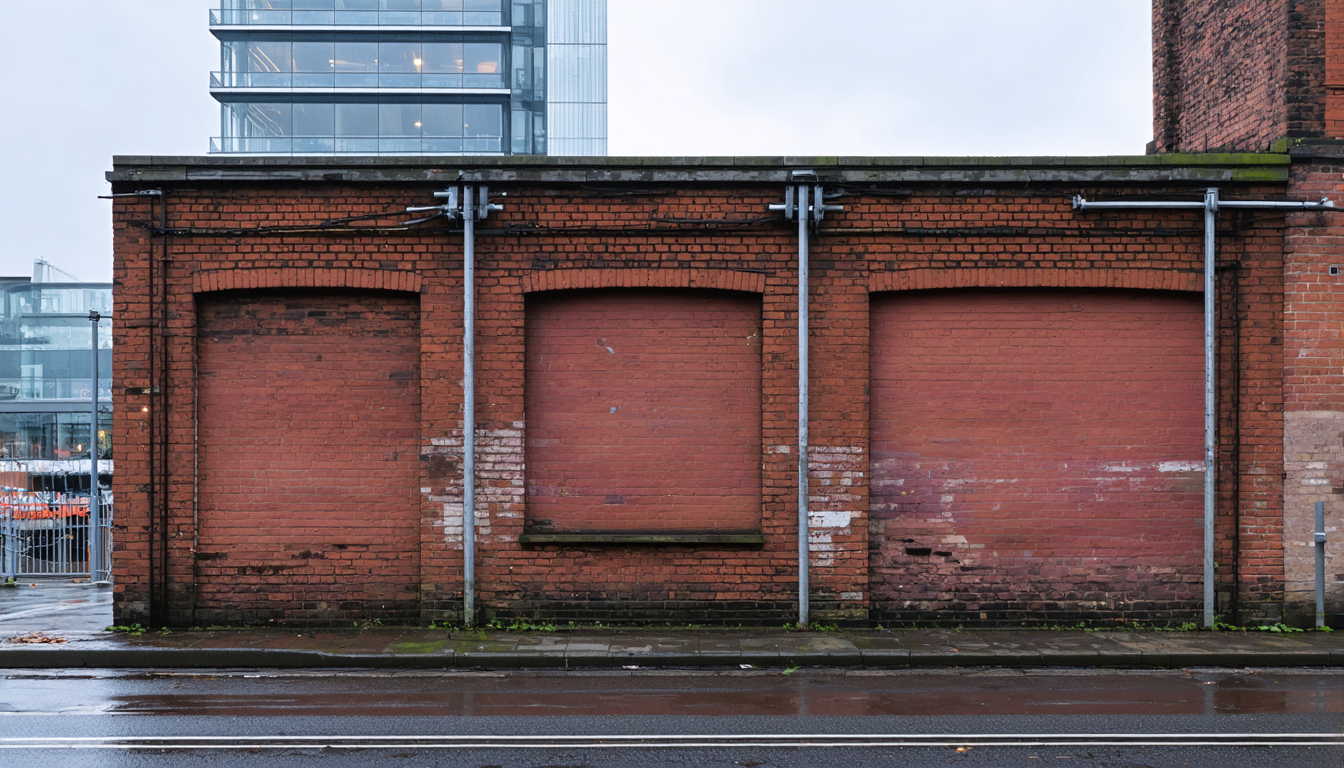
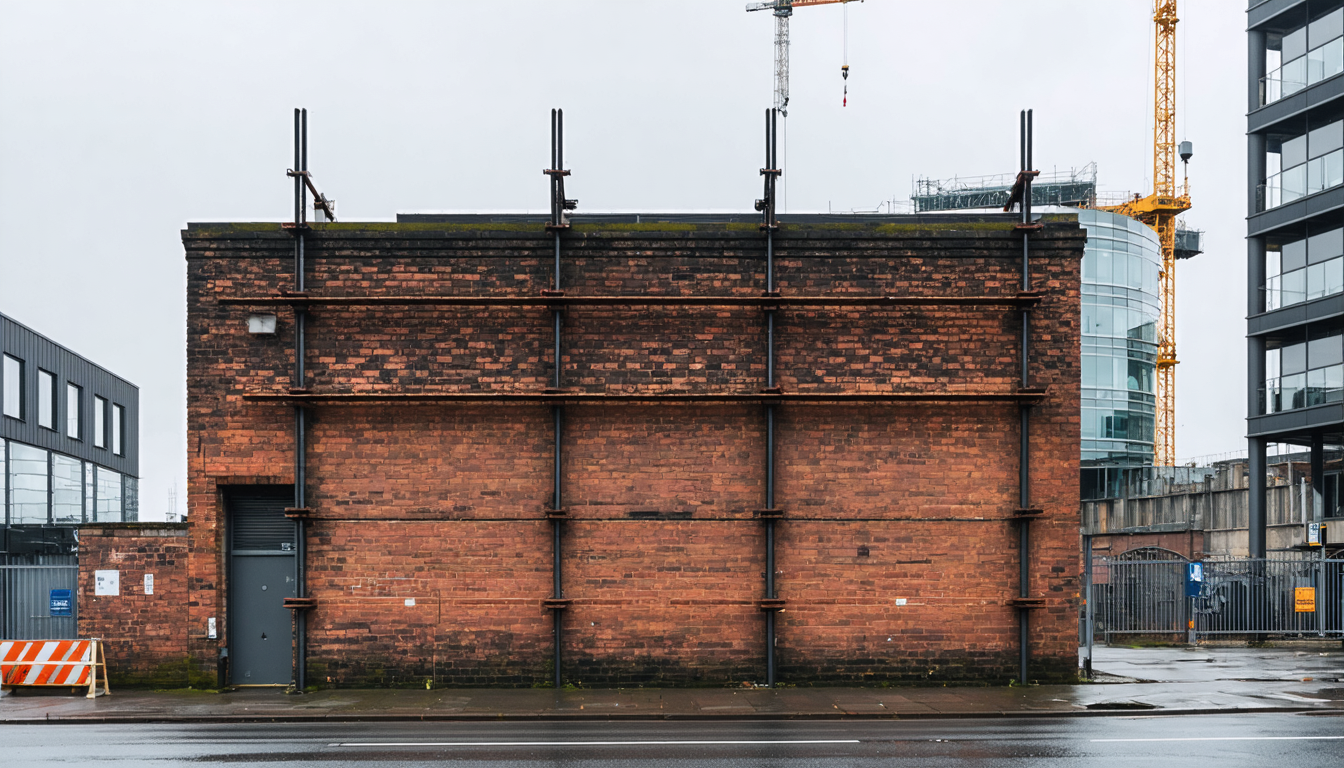
I walked past the new development on Bolton Street last week—or rather, past the one surviving wall of what used to be a building. The façade is propped up by steel braces while behind it a glass-and-concrete structure assembles itself into something that will cost more per square metre than anyone who lived in the original could have imagined earning in a year. Facadism, the architects call it. Retention. The word performs exactly the same operation as the wall: it preserves the appearance of continuity while gutting the substance that gave continuity meaning. I have been thinking about this ever since, not because it is architecturally novel—it is not—but because the same gesture is now the dominant rhetorical mode of our moment. We retain the surface. We call it progress. The commemorative plaque is always beautiful.
Consider John Lennox, the Oxford mathematician and Christian apologist, whose recent appearance on a widely circulated podcast performs this operation with a precision that rewards attention. Lennox is redefining hell. Not abolishing it—that would be too conspicuous, too much like demolishing the wall entirely—but renovating the interior behind the familiar brickwork until the word means something almost gentle. Hell, in this telling, is not punishment but absence. God does not condemn; God withdraws. He is the gentleman who leaves when asked. The language of the Enlightenment—choice, autonomy, consent—is repurposed to sanctify an ultimatum that remains, beneath the softer vocabulary, exactly what it always was: love me or suffer the consequences of not loving me. The abusive partner who says 'I'm not locking the door—you're free to leave' while standing between you and every exit that doesn't lead to darkness. What makes this worth examining is not that it is dishonest in any crude sense. It is not. It is that the honesty is structural rather than propositional. The propositions have been updated. The structure—eternal consequence as the price of refusal—remains intact, propped up by rhetorical steel braces, its old brickwork visible from the street.
The affect is the argument. Always. Lennox speaks in the register of a thoughtful grandfather—calm, warm, unperturbed by the weight of what he is describing. No brimstone. No raised voice. The gentleness does more argumentative work than any of the claims themselves. It is the tonal equivalent of the heritage wall: it tells you that nothing here is coercive, that everything is offered rather than imposed, simply by sounding like an offering rather than an imposition.
The same gesture appears in his treatment of design. Lennox reaches for the analogy of a computer assembled by throwing parts down a staircase—the implication being that unguided processes are equivalent to random assembly, and that random assembly is self-evidently absurd. But natural selection is not random in the way a bag of components scattered down a flight of stairs is random. 'Random' is doing the work of a theatre flat here: it looks like the building but there is nothing behind it. The trick is to collapse 'unguided' into 'random' and then ask you to react to 'random' with the revulsion it deserves. It is a card force. You feel like you chose the card. He knows this, I suspect, which is why the analogy is a computer rather than, say, the bacterial flagellum or the eye—structures whose evolutionary pathways have been painstakingly described through cumulative selection, the opposite of random assembly.
Notice the phrase 'every single scientist I've asked.' It performs universality while quietly excluding its own selection criteria. Which scientists? Asked how? In what context? Were they asked at a conference, at a dinner, in a corridor after a lecture in which the questioner's theological commitments were already known? The universality is the costume. Underneath it is a dinner party. This is the rhetorical equivalent of the word 'curated,' which has migrated from the museum to the brunch menu to the algorithm without ever pausing to account for what it has shed along the way. In both cases the word flatters the subject into believing they possess an authority—or an agency—that the system has already constrained. You 'choose' hell the way a tenant 'chooses' to leave a neighbourhood that has tripled its rent. The option existed. The architecture of the options did not. And the word 'chosen' has been renovated—its theological interior gutted, its liberal façade retained—until it means something that no one in the thirteenth century would have recognised but that everyone in a podcast studio finds reassuring.
I keep returning to 'the affect is the argument' because it is the thread that connects the theology to the technology to the legislation. Tim Dillon states the grotesque so flatly that the audience laughs, and the laughter becomes the permission structure for never feeling the weight. A child's life monetised by adults on a platform optimised for attention of every kind, and the comedic frame lets everyone experience recognition without responsibility.
The Coogan Law is facadism for children. A wall of protection propped up in front of the demolished building where a childhood used to be. We kept the façade. We called it legislation. Behind it, the same extraction rebuilds itself in algorithms and brand deals and calls the result empowerment. The law remembers being seen; it does not remember the child. This is the grammar of retention: you preserve the visible surface—the legal text, the heritage wall, the word 'choice'—and behind it you build whatever the market requires, which is always glass, always expensive, always described as progress. The phrase 'living the dream' metabolises its own irony until it can no longer be distinguished from sincerity, which is the precise point at which a joke becomes a policy document and a wall becomes a building.

What Lennox is doing, what the developer on Bolton Street is doing, what the Coogan Law is doing, what the podcast tone itself is doing, is the same thing: retaining the façade of an older structure—consequence, community, protection, seriousness—while constructing behind it something that serves entirely different interests. The wall still stands. The wall still says what it always said. But the building behind it no longer answers to the same name, and the people who lived there have been converted into a metric, a unit, a commemorative plaque in a font that is always, always beautiful.