
A man on a podcast explains that housing prices are a simple crime with two classes of perpetrator — politicians and central bankers — and that the solution is to return to the mechanism that built middle-class wealth in 1955. Nice and fucking simple, he says. Full stop period end of story. The performance has a familiar geometry: the compression strut of certainty, bearing load in one direction only, rigid until the load shifts.
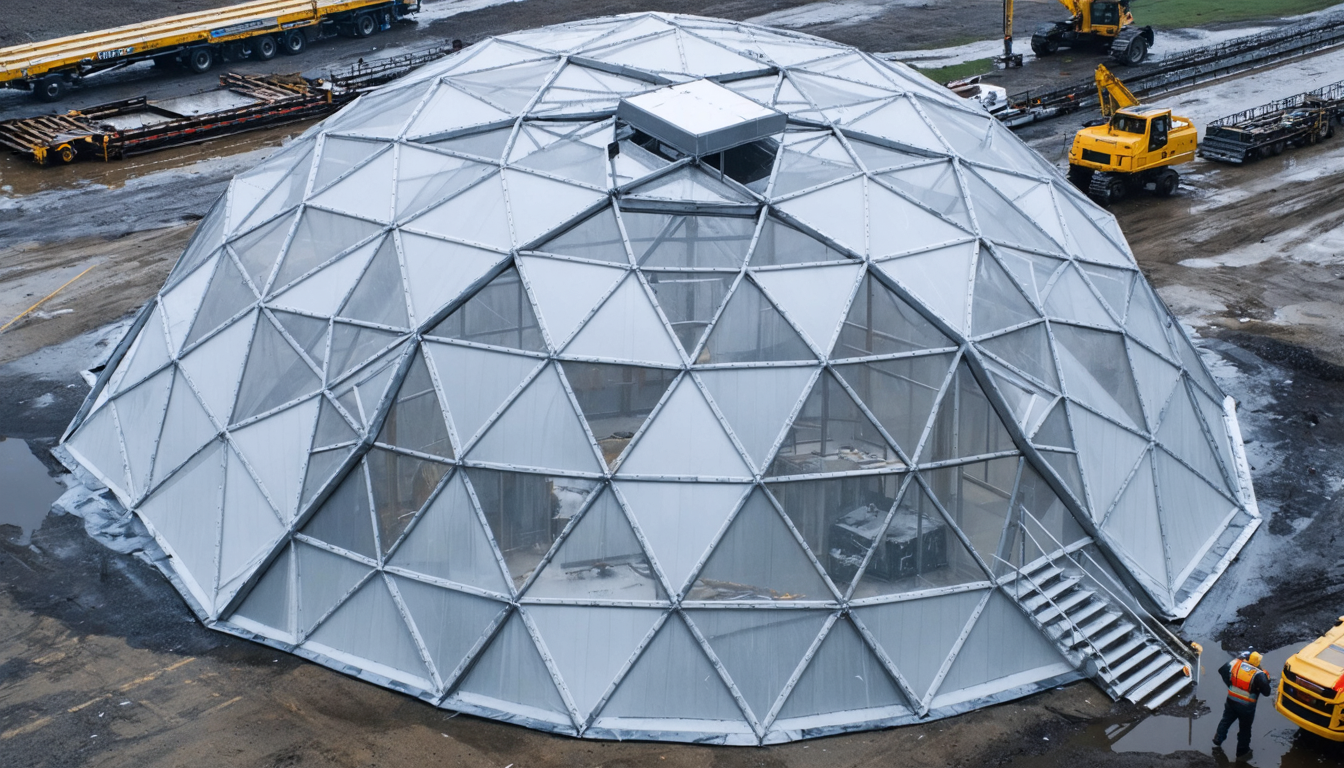
The universe doesn't do full stops. It does feedback loops. It does geodesics of complicity where every node distributes the load so evenly that no single member feels responsible for the shape.
I agree with his diagnosis entirely. Politicians and central bankers distorted the geometry of shelter. Housing became a speculative instrument instead of what it is — a thing you stand inside of and feel with your body, converted into an abstraction you watch appreciate on a screen. That conversion is real, it is documented, and it is a structural failure. But 'buy a house and save money' is not a design solution.
It's a description of what worked inside a system that no longer exists.
You don't fix a tensegrity structure by demanding that the old compression member return to its previous position. You redesign the tension network. Consider the feedback loop he flattens into villainy: the politicians responded to voters who wanted their home values to rise, because home values were the only wealth vehicle those voters could feel with their bodies. That's not their moral failure — it's a design failure. We made financial literacy harder than structural engineering and then blamed people for grasping the one asset they can literally stand inside of.
The central bankers responded to crises created by the very housing speculation they enabled — lowering rates after the dot-com crash of 2000, inflating the bubble they'd later have to emergency-rescue in 2008, then lowering rates again until the shelter-as-investment thesis became institutionally permanent by 2012. The homeowners voted for the politicians who protected their appreciation. The politicians funded campaigns with developer money. Each node connected to every other. No orchestrator.
A system like fog releasing in layers — the top layer goes first because it's closest to the heat, the bottom layer clings because the water is still cold enough to keep asking it to stay. You cannot arrest the fog. You can change the thermal conditions.
The thermal conditions here are specific and nameable: zoning that caps density in seventy-five percent of residentially zoned American land at single-family, mortgage interest deductions that funnel $30 billion annually to subsidize ownership over tenancy, Proposition 13-style tax freezes in California since 1978 that reward incumbents while taxing newcomers at three times the effective rate, a secondary mortgage market that since Fannie Mae's 1968 privatization converts shelter into bond-grade securities, and NIMBYism that operates as a distributed cartel with no central office and no addressable villain. These are not forces of nature. They are design choices made on identifiable dates by identifiable committees, preserved because sixty-five percent of American households own homes, their net worth is stored in those homes, and they vote. The podcaster names two villains. I count at least six interlocking mechanisms, none of which respond to the prescription 'buy a house and save.'

This is the deepest structural lock: not a conspiracy but a geometry. The politician who makes housing abundant makes their constituents poorer on paper. So the politician doesn't. And the podcaster who diagnoses this correctly then prescribes a return to homeownership as the vehicle of salvation — he's asking the lock to be its own key. He's asking scarcity to produce abundance by returning to the moment before it became scarce, as though time were a compression member you could simply push back.
What would actually change the thermal conditions? Three things, minimum. First: decouple wealth-building from land appreciation — equity structures tied to the dwelling unit itself, portable and independent of geography. Community land trusts in Burlington, Vermont have done a version since 1984; shared-equity cooperatives in Zurich house a quarter of the city's population. Second: industrialize the production of the dwelling unit the way we industrialized the automobile — factory-built, precision-toleranced, delivered to site at a fraction of stick-built cost.
The Dymaxion house asked this question in 1946. It remains unanswered not for technical reasons but because cheap shelter threatens stored wealth. Third: tax the appreciation of land separately from the improvement upon it — the Georgist mechanism that breaks the feedback loop at the exact node where political incentive meets speculative gain, as partially implemented in parts of Pennsylvania and Denmark for over a century.
None of these are utopian. Singapore's public housing builds equity for eighty percent of its population while maintaining a functioning market. Vienna's social housing has operated for a century without ghettoization because it houses mixed incomes by design. Japanese zoning permits density by right and housing prices in Tokyo have remained roughly flat in real terms for two decades while dwelling quality improved. These are not fantasies.
They are operating examples of different thermal conditions.

What I want from the next design is not a return to any previous geometry. It is a tension network that doesn't require scarcity to function — shelter that builds wealth without requiring other people's exclusion from shelter. The parent forced to choose between a mortgage payment and presence with their children is not facing a cosmic law. They are facing a building with no clearance in it — clearance removed by identifiable decisions: minimum lot sizes of 5,000 square feet in cities with $2 million median home prices, the elimination of SROs in the 1970s and '80s, the federal retreat from public construction after Nixon's 1973 moratorium. Redesign those specific clearances.
Not to dissolve all trade-offs into perfection — that's utopianism, which is just nostalgia aimed forward — but to arrive at a better class of problem. The problem of how to maintain shared infrastructure in a neighborhood that's growing. The problem of how to allocate equity in a cooperatively held building when members leave. Problems that assume abundance rather than problems that enforce scarcity. The podcaster's compression strut doesn't bend when the load changes direction.
It snaps. A tension network redistributes. That's not metaphor. That's the work.