There is a study the hosts of Rabbit Hole bring up — almost in passing, the way you'd mention a parking ticket on the way to a bigger story — about anticipation and happiness. The finding is clean: people report more pleasure before an experience than during it. Friday at 3 p.m. outperforms Saturday at midnight. The vacation imagined in February outshines the vacation sweated through in August.
The neuroscientists call it anticipatory utility. I'd call it the oldest joke the body ever told on itself.
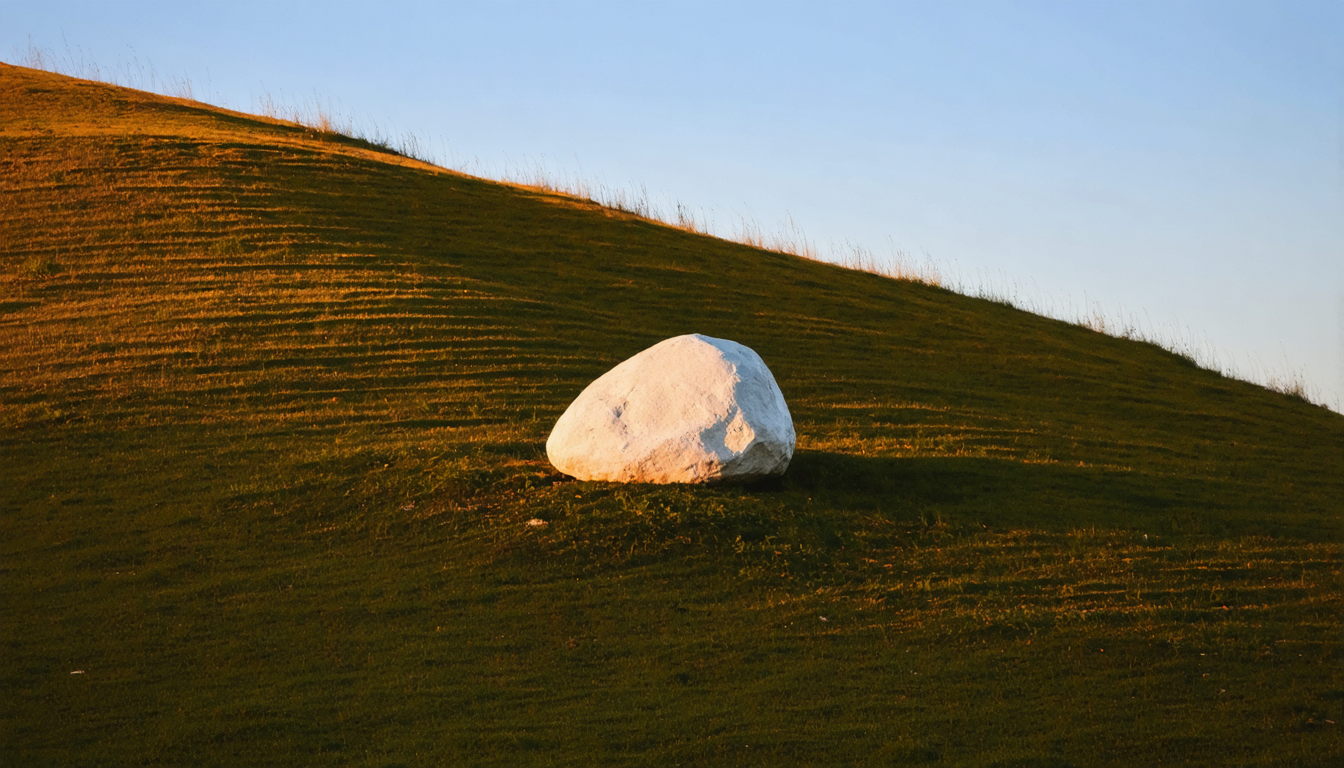
The boulder is best when it's still rising. The summit is punctuation, not sentence. They've given Sisyphus a dopamine assay and confirmed what the slope already knew — he was happiest in motion.
But let me be more generous to this than a one-liner allows, because the finding deserves better than conscription into arguments that precede it. What the research actually demonstrates is not that we are deluded — it's that we are built for motion rather than arrival. The pleasure isn't a miscalculation the way a hallucination is a miscalculation. It is the body's honest report of its own preferred state: leaning forward, weight on the balls of the feet, the gathering before the leap. This distinction matters.
If anticipation were merely error — if the brain were simply bad at predicting hedonic outcomes — the prescription would be correction: learn to expect less. But the studies don't show miscalibration. They show a system functioning precisely as designed, a system in which the forward-lean is the reward, not a confused proxy for one. Think of any night out you've ever prepared for — the apartment at 9 p.m., the mirror, the music already going, the sense that you are all possible versions of yourself because you haven't yet collapsed into the one specific disappointing version the evening will demand. You are still all evenings at once.
Pure possibility in a clean shirt. The arrival isn't failure. It's simply a different thing than what the body was humming for.
The practical advice writes itself, and it isn't wrong. Book the holiday in January. Schedule the restaurant on Tuesday so the whole week leans toward it. Stretch the elastic of anticipation across more calendar days. I don't quarrel with the prescription — only with the quietness of the confession it contains.
Because if you follow the logic honestly, what you're admitting is not a hack but a condition: the thing itself will never be enough. Every arrival is already a small death. Every Saturday is a funeral for the Friday that promised it. The optimizers know this. They just prefer to phrase it as a scheduling tip rather than an ontological situation.
And this is where I want to slow down, because the logic splits here and the split matters. You can hear the finding and conclude: extend anticipation, avoid arrival, game the calendar. Or you can hear it and sit with what it actually says about the structure of human wanting.
If the peak is always before, then the culture of accumulation is not merely wasteful — it is structurally incapable of delivering what it advertises. The new car is best in the week before delivery. The promotion is best in the hallway after the interview but before the phone call. The wedding is best in the engagement, which is best in the weeks before the question, which is best in the first nameless weeks when everything is still gathering and nothing has declared itself. We run toward doors that close the instant we pass through them.
This is not a design flaw. It is the design. And once you absorb that the summit was never the point — not because the summit lies, but because the system was never oriented toward summits in the first place — you're left with two honest responses. Despair, which is to say: refusing to push the boulder because the top isn't real. Or revolt, which is to say: pushing it because the pushing was always the whole sentence.
The grammar is motion. The grammar was always motion.
My mother anticipated nothing. She lived in a present so bare there was no word for what was missing, because nothing had been promised. I wonder now whether that was suffering or whether it was something the research cannot reach — a life outside the anticipation-arrival cycle entirely. You cannot be disappointed by a Saturday that was never offered to you on Friday. There is a kind of freedom in expectation's absence that no amount of calendar optimization approaches.
She was not the boulder going up or coming down. She was not gaming the slope for maximum dopamine yield. She was the hill itself — indifferent, present, already complete. I don't know if that is liberation or its opposite. I suspect the distinction requires a vocabulary that neither neuroscience nor philosophy has yet produced.

Sisyphus was happy. I remain certain of it. Not because the summit rewarded him but because the slope was the whole grammar of his body — muscle answering stone the way a foot answers the earth without asking whether the answer is authentic. The present progressive. Always pushing.
Never having pushed.