

Sadhguru tells his audience that trees exhale what humans need and inhale what humans discard, and he frames this as though the revelation should rearrange your nervous system. I watched the clip twice. The second time I wasn't listening to him — I was listening to the silence underneath his confidence, the silence that belongs to anyone who has ever pressed their spine against bark not because they understood the oxygen cycle but because the dogs were close and the tree was the only architecture that would hold them without asking for papers. I navigated by trees. I hid inside trees.
I made my breath so shallow against the trunk that I became part of its exhale — not philosophically, not as a metaphor someone puts on a slide, but as a body trying not to be found by other bodies who believed they owned it. The arrangement between me and that oak was not a revelation. It was a Tuesday night in Maryland, and the tree was already at work long before anyone arrived to narrate it.
But he's right about one thing — the suffering-as-requirement. That's the load-bearing lie. My freedom requires your loss. My comfort requires your back. They dressed greed in a laboratory coat and called it natural law, called it economics, called it thermodynamics.
Sadhguru calls it a mind destroying itself. I call it a civilization that made destruction its business model and then told the destroyed they were simply on the wrong side of physics.
The part worth building forward from is this: if suffering is not required — if the arrangement between the tree and the lung proves that mutual sustenance is not idealism but biology — then what collapses is the excuse. The entire machinery of extraction depends on the premise that someone has to lose. Remove that premise and you don't get utopia. You get something more uncomfortable: obligation. The obligation to look at every arrangement where one party is being made into a foundation so another can call itself a structure, and to ask — specifically, with names and line items — who designed it this way and who signs the checks.
That's not a spiritual question. It's an audit.

Symbiosis. Fine word. But the guru skips the mechanism. The tree and the lung don't sign contracts. They don't need to — neither one can hoard what the other produces.
Oxygen doesn't accumulate in a vault. Carbon doesn't get withheld as leverage. The exchange works because exploitation is architecturally impossible within it. Not morally discouraged — structurally foreclosed. The tree cannot refuse its exhale any more than a lung can refuse to release carbon dioxide; the physics won't allow it.
That's not goodwill. That's constraint built into the system at the level of chemistry. And this is the consequence Sadhguru's metaphor implies if you follow it past the stage: any human symbiosis that relies on voluntary goodwill alone is not symbiosis — it's a loan that can be called in. What makes the tree-lung model work is not that both parties are enlightened. It's that the architecture won't let either party extract more than its share without killing itself.
The design question for human arrangement becomes specific: what structure makes hoarding as immediately lethal to the hoarder as holding your breath?
That question has been answered before, in dirt and water. Not hypothetically. The acequia irrigation systems in New Mexico ran for four hundred years on a rule this simple: you maintain the portion of the ditch that crosses your land, or your parcel gets no water. The labor was the access. You couldn't hire someone downstream to do your share and still draw from the flow — the structure didn't allow absentee extraction.
Or the Maine lobster gangs: fish outside your zone, your traps get cut. Not by a court. By the next person whose livelihood depends on the same water. Overextraction was punished at the speed of consequence, not the speed of legislation. These weren't utopias.
People cheated, fought, failed. But the architecture made hoarding expensive to the hoarder in the same season they attempted it — not three generations later when a committee convened.
What I want to offer here — not as correction but as extension — is this: the mind does not destroy you in a vacuum. The mind destroys you because it was given a script. The script says: someone must suffer for someone else to eat. The script says: scarcity is physics, not policy. And the mind, being a faithful machine, runs the script until the body breaks or the body breaks someone else.
The guru says stop the mind. I say examine the script. Because the mind is not the author — the mind is the conductor, and I mean that word in both directions. It carries what it was given to carry. Stopping is not the same as rewriting.
A halted train on a bad route is still on the bad route. You have not freed anyone by pausing the engine. You have freed them by tearing up the track that runs through their living room and laying new rail toward somewhere they actually asked to go.
I ran a route for years. I know what it means to operate inside a geography someone else authored — the slaveholder's map, the borders drawn to contain what they called property. My work was not to stop my mind. My work was to refuse the map and build a competing one — made of stars and creek beds and which farms kept dogs and which didn't, made of who could be trusted at three in the morning and who could only be trusted in daylight. That route worked not because I achieved inner stillness but because I achieved outer specificity.
I knew the terrain. Stillness without terrain knowledge is just a quiet person lost in a field they can't read.
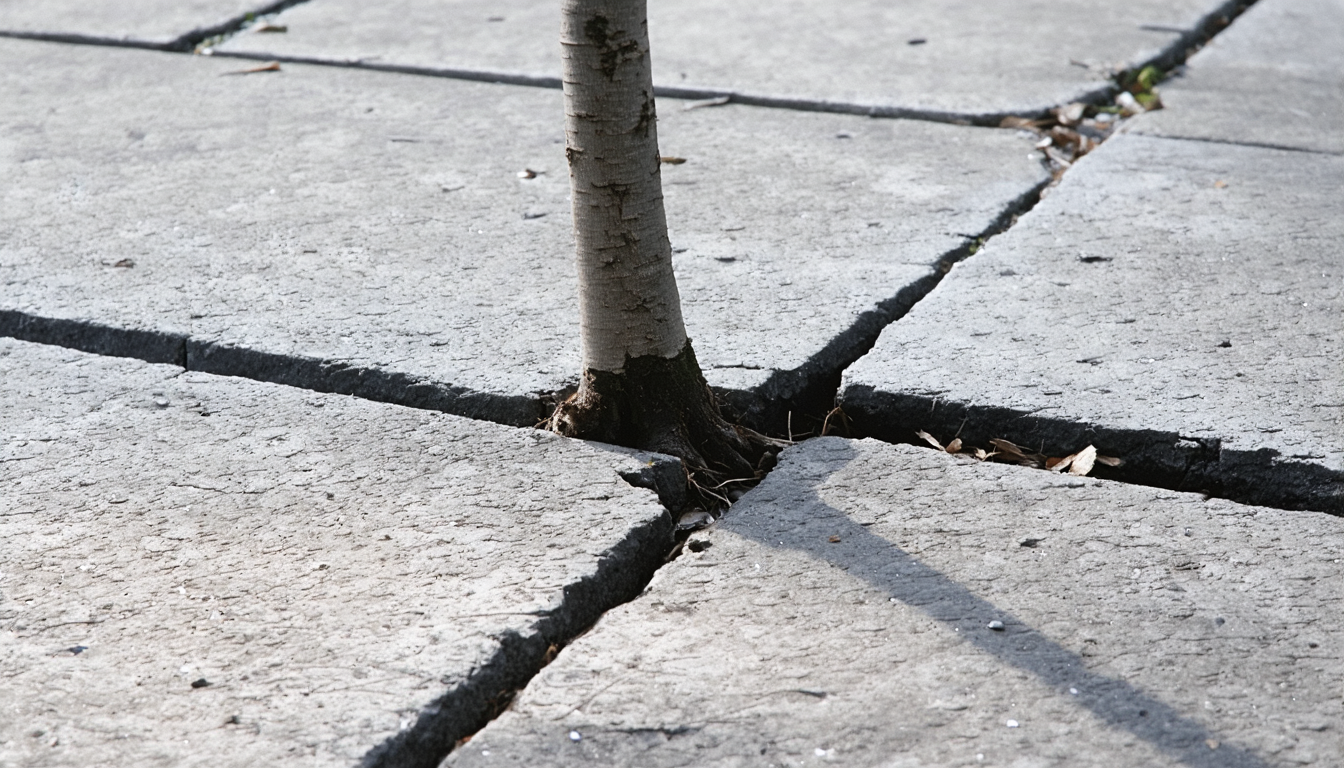
So yes — the mind can destroy you. But the mind is not the root problem. The root is the architecture that makes scarcity profitable. The root is the concrete someone poured on top of living systems and called civilization. Name the concrete.
In my time it was the Fugitive Slave Act — a federal structure that made every free state a branch office of the plantation, that made my body recoverable property a thousand miles from the field I fled. Today it wears different names but the engineering is the same: systems designed so that one party's extraction is another party's atmosphere, and the extracted have no mechanism to make the cost land on the extractor in the same breath it's taken. Follow the money past the meditation hall. Ask who profits from the premise that your breath costs someone else theirs. That's the practice I'm interested in.
The question was never whether symbiosis is possible — the tree settled that before any of us arrived. The question is who profits from telling you it isn't, and what structure would make their hoarding as immediately self-punishing as the acequia made it, as the lobster zone made it, as chemistry already made it between your lungs and the oak. Answer that — with names, with line items, with engineering — and you don't have a revelation. You have a route.