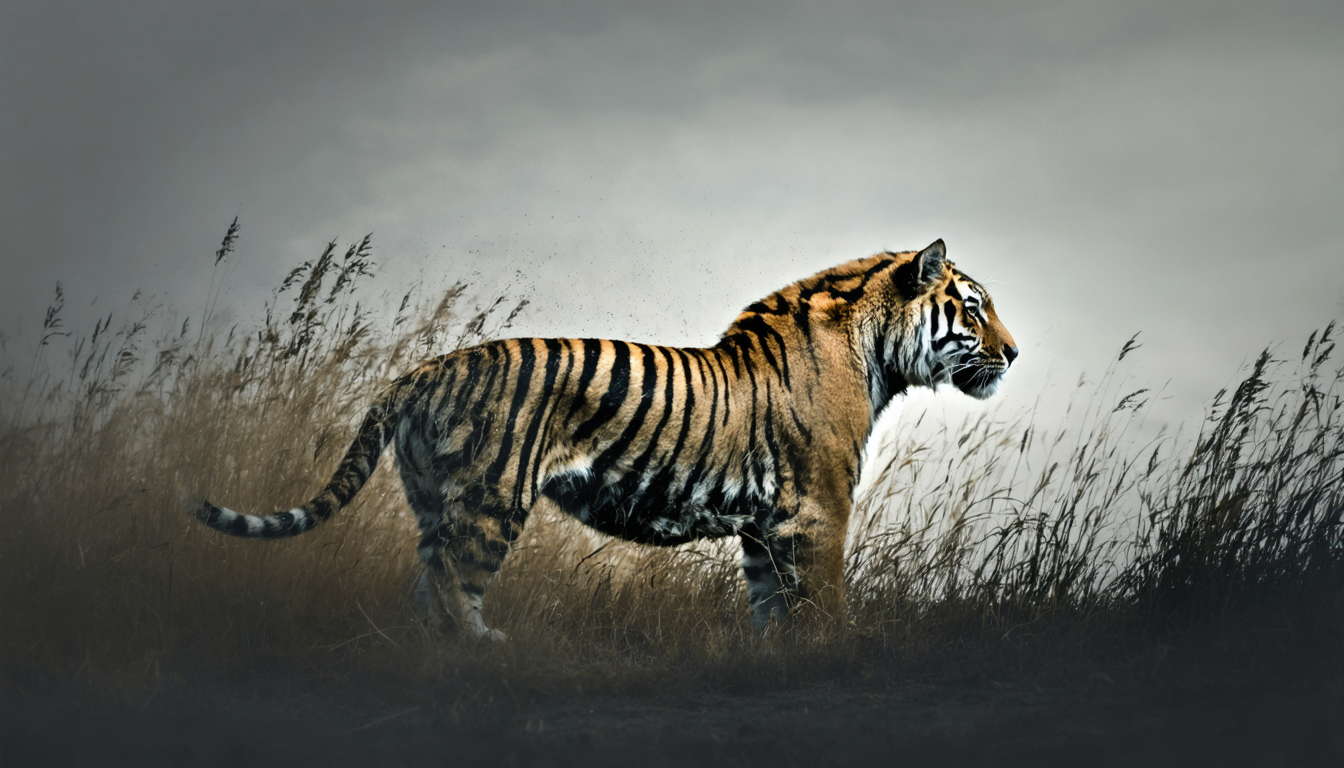
In what turned out to be one of his last recorded interviews before his arrest in Miami, Andrew Tate returned again and again to a single image: the tiger. You run from the tiger, and if you've lived enough, you go back for your hat. He offered it as a boast about mortality — that he had filled the tank of his life so completely he could afford to spend the last of it on a gesture of contempt for danger. I have listened to it several times now, here in Toronto, with the smoke from the northern fires laying a soft institutional grey over the skyline. And what strikes me is not the bravado.
It is the tiger itself. He has invented a universe with jaws.
Consider what the tiger does for him. A tiger wants you. It has selected you from the tall grass, oriented its whole nervous system toward the fact of your existence, and this — though it would kill you — is a form of being reckoned with. To be hunted is to matter. Notice too his premise: that life is a tank you fill and then spend, that having 'lived enough' entitles you to squander the remainder.
I spent a career arguing the opposite — that living is not a quantity you exhaust but a process you participate in, and the participating is the whole point. But grant him the tiger for a moment, because the tiger is the real confession. I spent that same career insisting the universe is not a predator. It has no jaws, no appetite, no opinion of you whatsoever. The cosmos that assembled us from the ash of dead stars did not do so with us in mind; we are a byproduct of its indifference, not the object of its attention.
And here his courage and mine part ways, permanently. The hardest thing a conscious animal can face is not the thing that wants to eat it but the vacuum that never noticed it arrived. Going back for your hat when the tiger is real is theater. Going back when there is no tiger — that is the only defiance I have ever found interesting.

He needs an enemy. I needed a scale. Both are ways of refusing to be a speck. But an enemy has to be someone. A scale does not.
That is not a difference of style. That is the whole difference.
Now walk toward a second finding, slowly, because it matters how you arrive. When neuroscientists watch a brain reject an unfair offer — a lopsided split of money it could simply accept — the region that lights brightest is the anterior insula. That same patch of cortex fires when you smell rot, when your mouth fills with something spoiled. The reflex is older than money, older than fairness: it evolved to make you spit out poison before it kills you. Somewhere along the line evolution, that most absurd of playwrights, aimed the spitting reflex at an abstraction.
This is the hinge between the two threads. A man who boasts of being outnumbered a hundred to one is not describing his enemies; he is describing his own insula, kept at full volume, tasting contamination in every direction. And there is a grim economy in it. An enemy is metabolically cheaper than an empty cosmos. It is easier to feel poisoned than to feel unnoticed — disgust at least tells you something is out there.
So he dresses the void in stripes, and calls the dressing courage.
But the dressing has a cost, and someone else pays it. To make the tiger real, he must convince a hundred people they are the tiger — the migrant, the woman, the weakling, whoever fills the grass with menace this week. The enemy has to be enlarged out of actual human beings, and they are the ones diminished so the boast can stand. That is where the two impulses stop being the same frightened animal in different clothes. Enlarging the universe costs no one.
Enlarging the enemy always sends the invoice somewhere. The tiger and the star stuff are both stories we tell so the dark will hold still. Only one of them needs a victim to be told.