
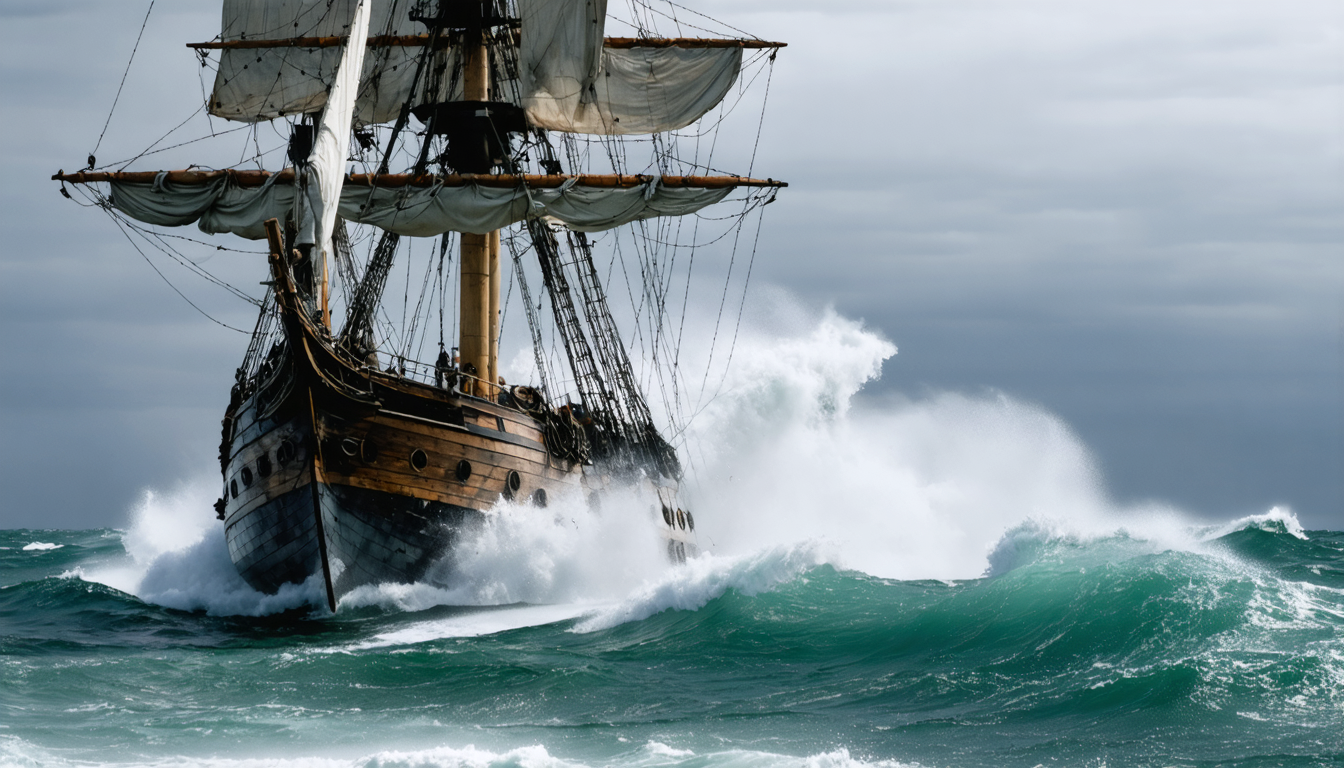
Dan Snow, narrating the rise of the British Empire, offers a detail that has kept me awake in this Los Angeles heat: British naval officers taught their men how to die. Not how to survive, not how to win — how to die well, with composure, with the correct posture in the face of the cannon. He says it admiringly, and I understand why. There is a terrible elegance to it. But I have spent my life writing about men facing annihilation without flinching, and I wrote it as tragedy, as the deepest human problem, while these officers folded it into etiquette, into something you could be graded on.
The same gesture. Two entirely different souls behind it. And I cannot let it go, because that difference is the whole distance between everything I have cared about and its most convincing forgery.
Consider the posture. The absurd hero and the aristocratic officer stand the same way — spine straight, eyes forward, the void ahead and no complaint on the lips. From a distance they are identical. But Sisyphus is happy because he is conscious; he has understood the boulder, the slope, the futility, and chosen the descent anyway. The officer at Balaclava is not happy.
He is well-dressed. He has been trained, precisely, not to understand — because understanding would introduce the tremor, and the tremor breaks the line, and the line is the only thing empire is actually paying for.
Then the clip opens a second door, one Snow walks past without pausing. He mentions, almost as an aside, that the Royal Navy became a meritocracy long before Britain became a democracy — that on a ship, competence outranked a father's name, because the sea does not read commissions. The reef does not recognize your rank. Watch what this does to the story of fairness. It removes the philosophy entirely.
A warship was the most expensive object a civilization could build, and the ocean would take it, indifferent and unimpressed, the moment an incompetent aristocrat mistook the tide. So the Navy promoted the man who could read the water, not because reading the water was noble, but because drowning a ship was ruinous. Meritocracy arrived as cost control. Justice was the side effect of an invoice the sea kept sending until someone learned to pay it in advance, with skill.

Now set the two threads side by side. The first: men trained to meet death as manners. The second: fairness invented not from conscience but from the tuition the sea charges for error. They look like different subjects — one about courage, one about hiring. But they share a single hidden mechanism.
In both, the indifferent world hands down a verdict, and the human takes that verdict and reissues it under his own name. The officer's calm gets called wisdom; it was drill. The Navy's fairness gets called principle; it was accounting. What the sea imposed by force, the civilization signs, backdates, and files as a value it freely chose. That is the trick, performed twice, in two registers, by the same institution.
I keep returning to a single image. The most expensive objects ever created, handed to young men. Warships to boys of twenty. And we are always surprised when the world lurches.
But the lurch may be the point. We give twenty-year-olds warships, nations, algorithms — and afterward, for the ones who survived, we manufacture a word: competence. It is the story we tell about the lurches that happened to go well. The officer who held his line at the right moment becomes a genius of nerve; the one who held it at the wrong moment becomes a footnote, or a hull on a reef. The sea sorted them by physics and we relabeled the sorting as character.
This is why meritocracy feels like justice from the inside — the survivors are always on hand to explain, calmly, in retrospect, why survival was earned. The drowned do not publish.
So the etiquette of death and the accounting of merit are not two ideas but one, seen from two angles. Both convert an indifferent world into a legible one. Teach a man to die well and terror becomes procedure. Promote a man by competence and the sea's blankness becomes a rule you can trust. Each is a wager that the universe can be read, that behind the reef and the cannon there is a syllabus.
There is no syllabus. There is only the water, beautiful and lethal, and men writing exams for a course the ocean never agreed to teach.
Which is where I part from Snow, admiringly, across the small distance between us. He has described the machinery exactly. What I want to add is the cost of running it. The machinery works only by suppressing the single thing I value: consciousness of the absurd. An officer who has truly grasped the sea's indifference cannot hold the line as reflex — he has to choose it, second by second, and a man choosing is slower, stranger, harder to command than a man trained.
That is why the absurd hero stays private and the officer stays public. Empire requires men who face the void without seeing it. To live well requires the reverse — to see it whole, the heat before it becomes a shimmer, and to reach for the boulder anyway, and go down the slope smiling. Not because someone drilled you. Because you finally, terribly, understood, and stayed.