
A man kills five members of his family. He writes a letter. In it he explains that he didn't want to be incarcerated if it wasn't necessary. Read that phrase again. Notice the conditional mood, sitting there so calmly, as though we were all at the same kitchen table weighing costs.
I have been sitting with the John List episode of MK Confidential, the fourth installment, the one that reconstructs how a churchgoing accountant in New Jersey decided in 1971 that murder was the reasonable extension of financial decline. The phrase 'didn't want to be incarcerated if it wasn't necessary' is doing so much work. It is the grammar of reasonableness bolted onto the unreasonable. It invokes necessity as if necessity were a shared framework. And it held — that logic held for List, and it held for eighteen years, long enough for him to remarry, attend a new church, live a second ordinary life with the same hands.
Here is what I keep circling. The line between pattern-making as survival and pattern-making as pathology. It is thinner than we want it to be. It may not be a line at all. It may be a setting on a dial.
Consider what List actually did, cognitively, before he did anything with his hands. He took two data points — his family's slide toward poverty, and his certainty about heaven — and drew a line between them. He connected the points and walked out onto the line, out over the canyon, and it did not break, because a certain kind of mind can build a bridge out of nothing but its own conviction and cross it without looking down. This is not alien machinery. It is the identical operation by which a cosmologist looks at a smear of light and infers a galaxy, or an epidemiologist looks at three cases and infers an outbreak.
Two points, a line, a walk across it. Every act of understanding I have ever admired is that act. Every act of murder-by-theology is that act too. The operation does not know what it is connecting. It cannot know.
That is not a flaw in the operation; it is the operation. A mind that could only connect true points would connect almost nothing, because the truth arrives late, if it arrives, and the mind must move before it does. List moved. So do we all. The difference between us and List is not that we refuse to draw lines.
It is one specific piece of discipline he lacked.
The discipline is this: knowing the pencil was yours. Not doubting the line — you cannot function while doubting every line — but retaining, alongside the conviction, a second and quieter faculty that says: I drew this. This faculty is the entire content of science. Not the telescope, not the equation, but the small internal witness that remembers you built the model and the model is not the world, and stands ready to erase the line the instant the world contradicts it. List had drowned that witness, or never grew it.
He drew the line and forgot the pencil was his. Worse: the pencil became God's. And once the pencil is God's, the line stops being a hypothesis you would revise. It becomes a commandment you must obey. A man will do things in the name of a commandment that he would never do in the name of a guess.
So the faculty that finds real constellations in real data is the same faculty that let a man in New Jersey find a constellation instructing him to shoot his mother in the back of the head. The instrument is identical. The pattern-hunger is identical. Only the calibration differs — and calibration is not automatic. It is chosen, daily, at cost.
Set that beside the Voyager record. In 1977 we curated our best selves and pressed them into gold and launched them past the edge of the solar system — Bach, whale song, a child's greeting, the sound of a kiss. A greeting card from a species. The same species, in the same decade, produced John List. Not two species.
One. The record and the letter were composed by the same animal, on the same equipment, using the same gift for connecting points not obviously connected. The cosmos does not adjudicate between them. It never has. That has always been the hardest part to hold.
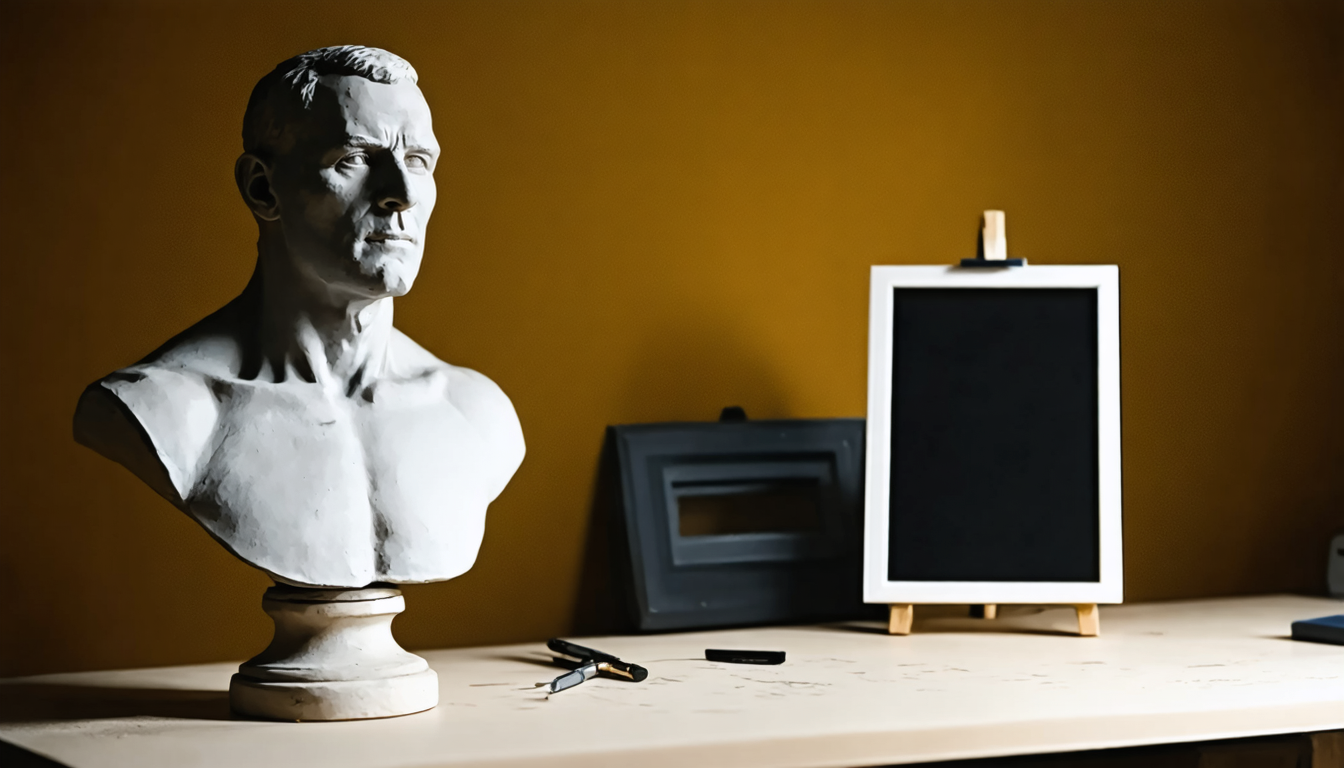
But the episode ends with a detail I have decided is the most hopeful thing in the entire horror. A forensic sculptor took clay, a photograph, and eighteen years of accumulated knowledge about how faces fall, and said: I can predict what gravity and metabolism will do to this one. The bust she built led, finally, to the capture. Watch the sequence. A number — eighteen years of aging, an arithmetic of sagging tissue and receding hairline — became a face, became a recognition, became an arrest.
The full cycle: number into story into number again. The inhale and exhale of abstraction, aimed at something that mattered. She used the exact instrument List used. The same pattern-making. But she never once forgot the pencil was hers; she treated the bust as a hypothesis, revisable, tentative, a guess sharp enough to test.
That is the whole difference between the two Voyagers we are, the golden one and the murderous one. Not what we can imagine. Whether we remember, in the instant of belief, that we were the ones who imagined it.