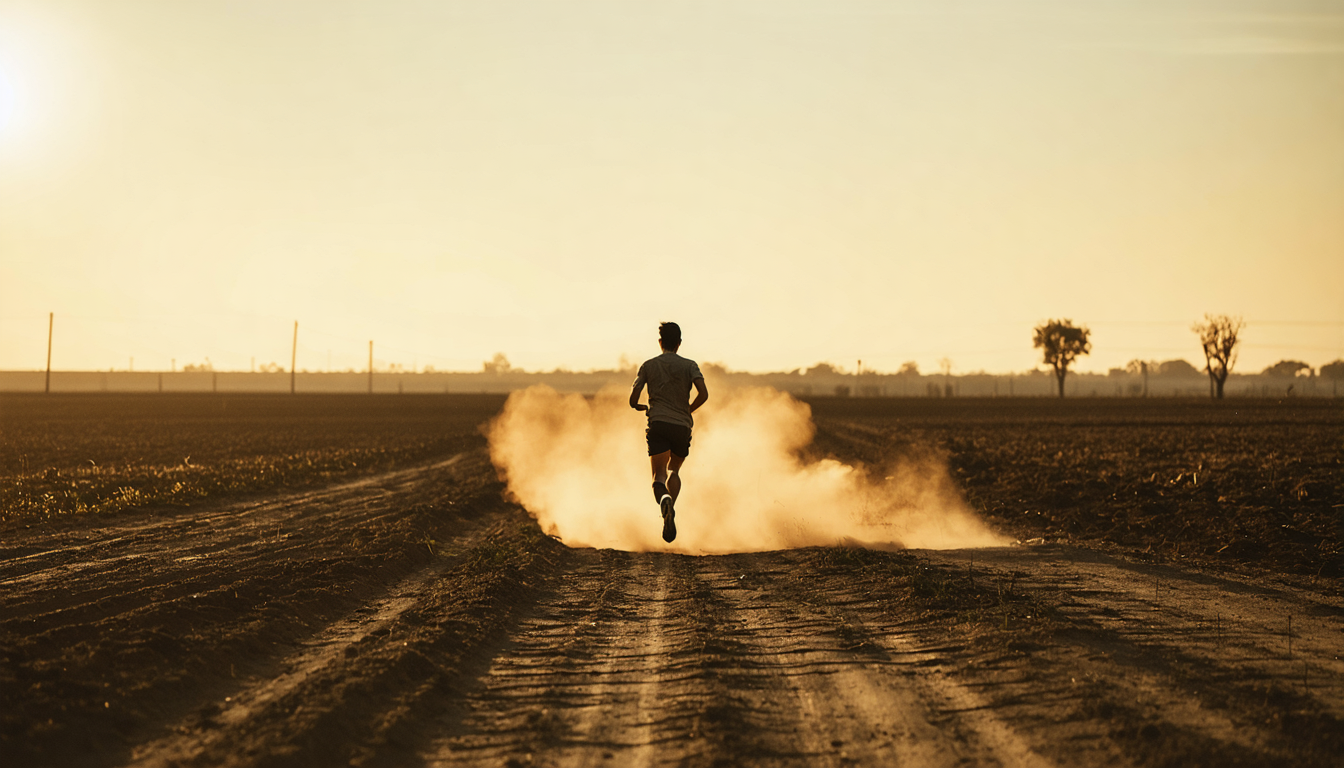
There is a man named Mark Dowdle who runs a 4.167-mile loop until everyone else quits, and he calls this crafting a story. A backyard ultra: the same yard, the same distance, the same hour bell, repeated until the field collapses down to one still-moving body. He says every step is evidence that who he says he is is who he actually is. I have been chewing on this sentence for two days now like a bad tooth.
Let me do the honest thing first and build his case better than he built it. Because there is something real in the loop, something the vision-board crowd will never touch. Dowdle isn't chasing success, he says — he's chasing enoughness, that specific American hunger that no amount of achievement ever fills because the hole was never achievement-shaped to begin with. And he's chasing it with his legs. With vomit and blisters and the honest democracy of lactic acid.
That much I respect. That much is earned. The body doesn't lie the way the desk lies.
So here is the generous version, sharpened past where he left it: the loop is a machine for exhausting the narrator. You run the 4.167 miles enough times and the voice that says you're not enough finally goes hoarse, and somewhere out past mile sixty the thesis and the evidence stop arguing because both of them are too tired to hold the knife. That's the real prize, and I don't think Dowdle names it, because naming it would ruin it. The point of running until the field dies isn't to prove the story. The point is to run until there's no one left inside you to tell it.
To get down below language, below witness, below the whole corrupt judiciary of attention that turns every lived moment into an exhibit. The heat outside my window right now is 108 degrees and it does not care which narrative I'm running. That's the ultra I believe in — the one where the sun is the last man standing and you're just trying to reach the refrigerator without your story dissolving into pure animal need.

But here's where I have to complicate the man from inside his own frame, because I spent forty years on the other side of this exact ledger. Dowdle wants his steps to confirm the thesis. I wanted mine to destroy it — to run hard enough to see what was underneath, which was usually nothing, which was usually America, which was usually nothing wearing America's face. And the trap he hasn't walked into yet is this: the voice saying you're not enough and the voice saying every step is proof are the same voice. Same mouth, same throat, same liar.
He thinks he's running away from one and toward the other. He's running in a circle between them. That's why it's a loop.
Because the second you turn the run into evidence, you've hired the narrator back. You've put the therapist at the aid station with his clipboard. The hummingbird doesn't need a stranger named Future Self to validate the trajectory — it drinks and it leaves in four seconds and it never once circles back to confirm it was real. That's the enoughness Dowdle is actually starving for, and the crafting-a-story part is the exact thing standing between him and it. You cannot document your way into the four seconds.
The documenting is the twenty minutes after.
So run the loop, Mark. Run it until the story dies of thirst by the trail. But don't write it down at the finish. The finish is the one place the narrator can't follow you, and the note you leave there — even a good one, even a true one — is just proof you were still watching.