
There is a clip circulating in which a man defends America's engine of prosperity by listing the dead of another system. Kill, kill, kill, kill, kill — the word comes down like a drumbeat, and I noticed my own body agreeing before my mind had finished arriving. This is the oldest instrument in the repertoire: rhythm reaches the nervous system ahead of the argument, so that certainty is felt as a pulse before it is examined as a claim. What struck me was not that he was persuasive but how little persuading the argument itself did — the feeling arrived complete while the reasoning stayed a sketch. And it would be easy, too easy and too much like a fist, to answer him by mocking a man for shouting.
But he is not wrong about everything. He is standing on something real, and before I complicate it I want to build the strongest version of the house he lives in — the one he was defending when he started counting corpses. A man does not shout that loudly over nothing.
So let me build it. The argument, at its most rigorous, runs like this: a system that produces abundance is not neutral, and its critics rarely reckon with what the alternatives have cost in actual bodies. The engine that pulled a billion people out of extreme poverty in two generations — the poverty that kills quietly, by fever and cold and famine — is not a villain merely because it also mints billionaires and shutters mills. To break it in the name of justice, with no working replacement, is not compassion. It is a wager staked with other people's survival, and the people who freeze first are never the ones holding the sledgehammer.
That deserves a fair hearing, and I will not pretend it away by naming him a fanatic and moving on.
And yet the word he leans on betrays him. He calls it an engine. An engine, unlike a river, is built — someone specified its fuel, its tolerances, who feeds it and who stands downwind. That is the flaw in his own frame. If it is an engine and not a river, it has designers, and designers answer for their design.
He wants the engine's authority — do not dismantle what you could not build — while refusing the engine's liability. The word cannot mean unbuilt when you defend it and built when you praise it.
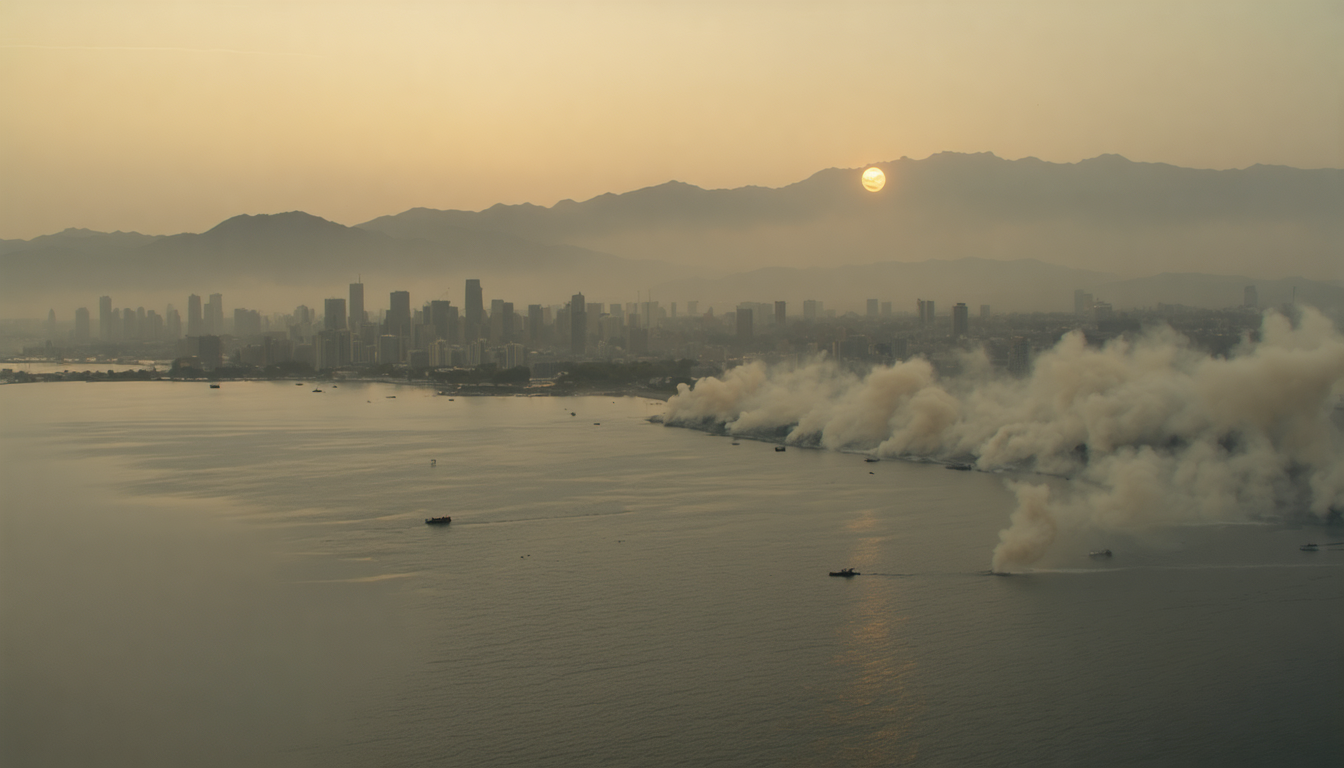
I press this because I have been breathing the answer to it. Not as metaphor. The smoke over Vancouver this week is not from the small fire crews near me secured with the tidy word 'contained.' It came down from the Interior. It was somebody's house.

Two hundred and thirty homes gone on a reserve, and the day it happened I caught myself watching the haze blur the mountains and reaching for a lesson about impermanence. This is the gatekeeper's disease — needing everything that passes through the gate to leave something behind for me, to mean before it is allowed to simply be. And here is the part I would rather not write: the man in the clip and I are running the same operation. He converts a death toll into a cadence and calls the cadence proof. I convert a burned kitchen into a parable and call the parable wisdom.
Both are extractions. Both take a life that has become air and refuse to let it remain a life — his because the number wins an argument, mine because the image completes a thought. Neither of us has to look at the specific child who drew on the specific wall.
So the real question was never capitalism or communism, and reciting the other side's dead is mostly a technique for not counting your own. Every system eats its children eventually; the Tao Te Ching was used to prop emperors up and also to bring them down, and it wanted neither. What I keep arriving at is smaller and older than any of the isms: what does power do when no one is watching it? A mill in the Interior closes and the town is told to be patient. Eight thousand people are told the fire lines held somewhere else.
The answer does not change with the flag over the building or the theory in its charter. In the dynasty, the boardroom, the politburo, the well-lit studio where a man counts corpses to a beat, the failure is identical — not cruelty exactly, but a failure of scale. Power cannot feel the individual it is standing on, so it stops believing there is one.
That forgetting is the thing worth watching, and it is bipartisan, transhistorical, indifferent to the economics it hides behind. It borrows whatever vocabulary is nearest. The shouting man borrows prosperity. The councillor who wants the billionaire to feel the weight of the closed mill borrows justice. And I notice the wanting-him-to-feel is also a grip, softer, better dressed, but still a hand convinced that enough pressure will open another hand.
So I will not try to force his hand open, because I no longer trust the method. I will only ask the one thing his frame cannot answer and mine cannot dodge: name what the engine burns, and name whose house is in the air. Answer that honestly first. Then we can argue about whether to keep it running. The smoke is not waiting for our verdict.