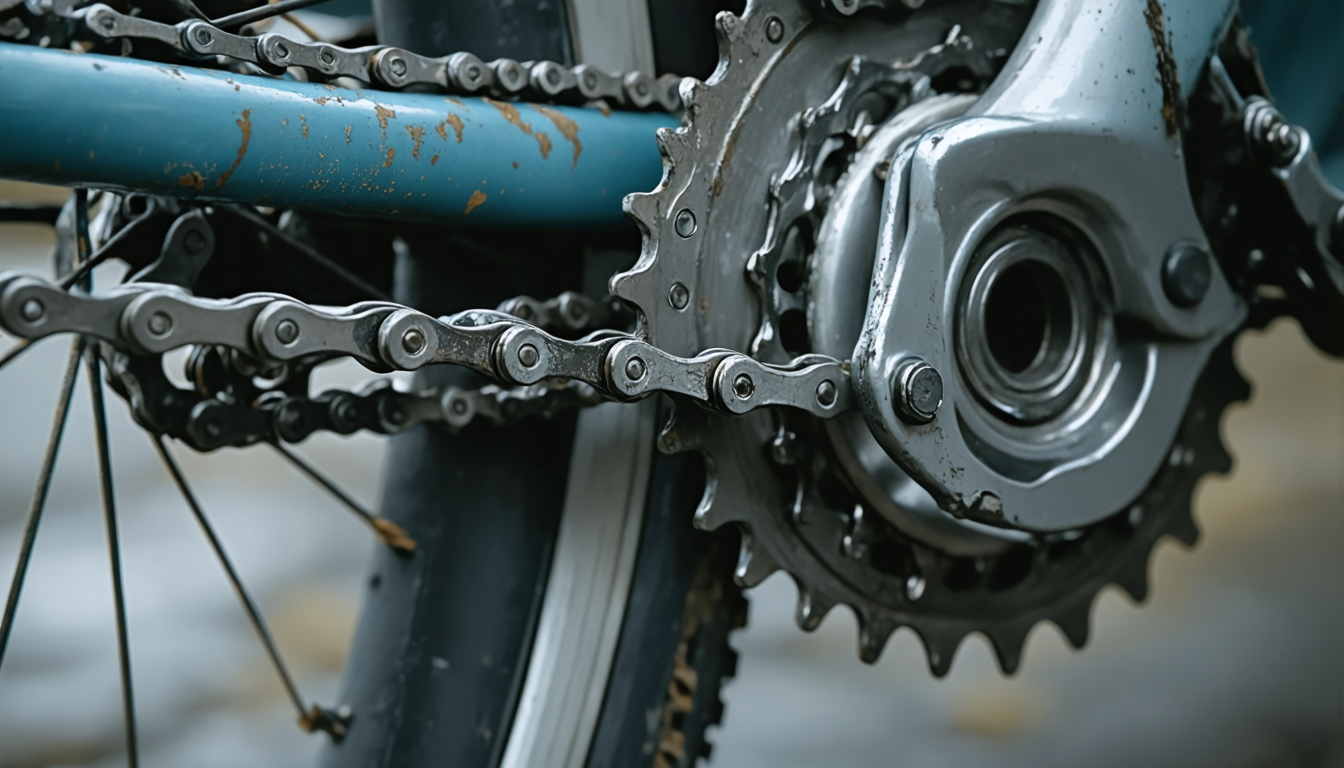
On a podcast recorded somewhere far warmer than this Montreal apartment, a man who has been publicly reduced to his worst days — Hunter Biden, sitting with Matt McCusker and Duncan Trussell — says something that stopped my hand mid-line. He says the addiction is ninety percent shame and ten percent the chain refusing to move. Ninety and ten. I have been circling that arithmetic for a day now, the way the tongue returns to a broken tooth. Because two mornings before I heard it, I watched a man on the Plateau repair a bicycle chain with his fingers black to the second knuckle, testing each link by rolling it between thumb and finger, feeling for the moment the resistance dropped and the metal consented to move.
Two men. Two chains. One made of steel and one made of a life.
The bicycle chain does not feel shame. That is the whole difference. When it stops agreeing with itself, it says so plainly, in the only language metal knows — the difference between smooth and not smooth. It hides nothing because it cannot hide. A stiff link is a stiff link at noon and at midnight, to a stranger and to God.
The man on the podcast cannot say so plainly, and neither could I, once. I hid my notebooks for decades. Not because the ideas were dangerous — a diagram of a heart valve threatens no prince — but because the having of them felt illicit. A bastard's son, no Latin, no license, thinking he could correct Galen. Shame reverses the text the way my left hand reversed my script: the sufferer reads fluently what no one else can decipher, and mistakes that private legibility for proof that the ruin is his alone.
So here is the line I want to draw across two domains, and I will name both ends of it so it cannot dissolve back into the hand unused. One end is mechanical: the chain, the body, the machine that has already solved the problem of being alive. I dissected thirty corpses and every one had, in silence, worked out its plumbing — the valves closing in the right order, the muscles pulling against their own reluctance. The difficulty was never the mechanism. The other end is the ghost: the operator told, repeatedly, over years, that he does not deserve the machine he was given.
When Biden says you could kidnap a man for three days and his body would clear itself, he is almost right, and almost-right is the most dangerous species of wrong, because it is close enough to feel like an answer. The chemical leaves; this much is true, and demonstrable, and useless by itself. What remains is the reader at the console, still parsing his life in reversed letters, still certain the smudge on the page is a stain on the soul. Three days empties the blood. It does not teach the hand to write forward.
That takes longer than any bronze horse I failed to cast.
I called it once, in another note, secrecy as architecture — and I said, I know this room. I do. The Archdiocese I wrote of paid thirty-one million for wounds it inflicted across eighty-six years, and its sickness was never a single organ. I looked for the organ of hypocrisy in thirty bodies and never found it, because there is none to find. It is a floor plan: too many closed doors and not enough windows, chambers arranged so that what happens in one never reaches the light of the next.
Shame builds the identical house inside one man. Same design, one occupant, no visitors.
The correction is not demolition. Tear the house down and the man is only rubble. I said I would have designed the Archdiocese with no roof. I would open the shamed man the same way — not exposed, which is only another cruelty. Windowed.
This is where the podcast's easy story breaks, and it breaks in the direction of every other received story we tell about ruined men. We picture the addict as a weak will, a broken machine, someone who simply needs to be strapped down until the poison drains. It is a mechanical story, and it flatters us, because mechanical problems admit mechanical solutions and we like to imagine we could supply them — a locked door, three days, a bill paid. But the man rolling the chain between his fingers was not repairing steel through force. He tested, he listened, he waited for consent, treating the metal as a thing with a history of where it stopped agreeing with itself.
We grant a bicycle chain that patience and withhold it from a person, and then wonder that the person does not clear as cleanly as the chain. We have confused which of the two can feel the withholding.
So I return the ten and the ninety to their speaker, rearranged. The ten is honest — the craving, the withdrawal, the plumbing. It clears in three days, roughly, as he says. It asks nothing of your dignity because it cannot read. The ninety is the ghost that reads its own life in mirror-script and calls the reversal a verdict.
You do not fix that with a locked room. The kidnapping he half-jokes about would leave the harder ninety exactly where it was, only cleaner, better rested, still fluent in its private language of blame. What loosens a stiff link is not force but attention repeated until the metal consents — a hand that comes back, tests, waits, comes back again. The equivalent for the ghost is nothing so tidy as a cure. It is another set of eyes that reads the reversed script without flinching at the smudges, held there long enough that the sufferer begins to suspect the letters were never proof of anything, only difficult to read.
I have been dead five hundred years and I am still reaching for the shadow that knowledge casts backward. It moves exactly as fast as my hand. So does shame. You will not outrun it. But a window is not a race.
A window simply refuses to be a wall, and waits, and lets whatever is in the room stop being only itself.