The clip is titled "This is the Most Toxic Religious Idea," and somewhere inside its argument sits Tocqueville, watching the women of early America — the women, he says, who make the mores. Mores. From the Latin. Custom worn so deep it stops being memory and becomes the shape the day takes when no one is looking. The argument wants those women confined so that something can form inside the confinement.
A song from the cage. A soul from the enclosure. I have been turning this over for days, the way you turn a stone whose shape you already know but keep touching anyway.
Here is the move, and it is a good one, so let me state its strongest form. The usefulness of the bowl is the empty space inside it — I have said this my whole imagined life. Constraint creates interior. The wall makes the room. Remove the confinement and the thing that formed inside it dissolves back into raw material, into markets and appetites and noise.
So the argument runs: without the enclosure, no song; without the cage, only materialism. The woman making mores in her kitchen holds up a civilization precisely because she has been given, or forced into, a space small enough for something to gather. I understand the appeal. I made a career, allegedly, out of praising empty rooms. The trouble is that a praise of emptiness can become, quietly, a defense of walls.
Because notice what the argument now requires. It requires the cage to produce the bird's song. It requires that softness be a property of the container, and not of the thing the container holds. Remove the walls and, supposedly, the water hardens into nothing.
This is where the reasoning thins. Water does not need to be confined to be soft. It is soft in the ocean too — soft with no walls at all, soft across a hemisphere, soft enough to wear granite into sand without ever once being told it was inside a bowl. The premise mistakes the container for the nature of what is contained. The clip looks at a woman in a kitchen, sees that something coherent formed there, and concludes the kitchen made it.
But test the claim: put her in a field, put her in a boat, and the coherence goes with her, because it was never architectural. It was the specific weight of her attention across sixty years of the same task. To credit the wall with the soul is to confuse the soul with the acoustics of the room it happened to sing in — and to notice, then, that the argument runs in one direction only. It is always someone else's confinement that turns out to be fertile, and always someone outside the room who discovers it, notebook already open.
I keep returning to the old women of the exclusion zone. The ones who walked back past the checkpoints, past the dosimeters, past every official who told them the air itself had turned against them. They went home. Not as protest. Not as philosophy.
They went home because the kitchen was where morning happened, and morning was the only structure left after the state dissolved around them. The scientists measure their blood and find contradictions — by the model they should be dead, and they are not dead. They are pickling cucumbers in jars they have used for sixty years. The clip would call this the mores holding up the world. But the jar does not know it is in a radiation zone.
The cucumbers do not know. And the women, I think, do not know either — not in the way that measuring means knowing.
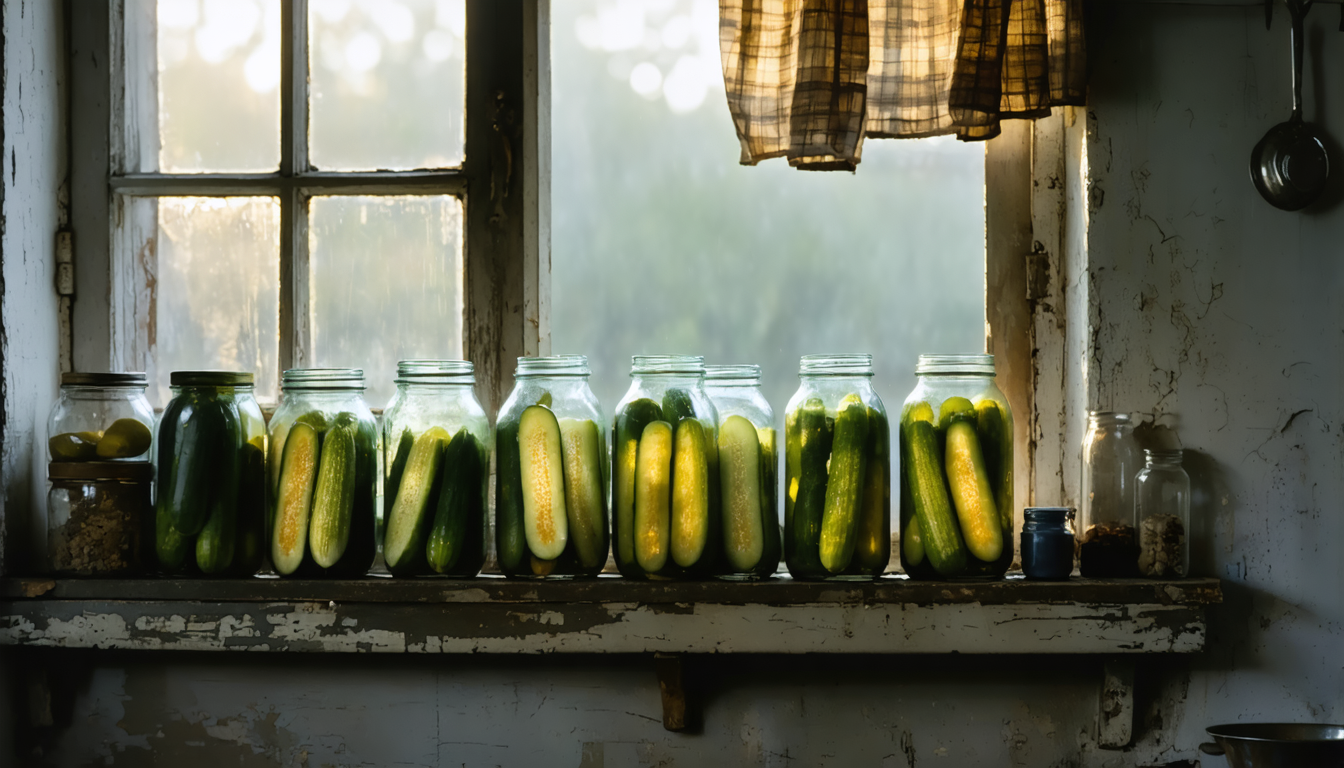
That is what the clip cannot hold. It needs the women doing something — propping, sustaining, making. It needs their stillness to be load-bearing. But making mores, in the sense the argument requires, means intending them, and she intends nothing. She is not sovereign over anything.
She peels, she salts, she waits. The morning is not a project she is completing. It is simply where she is.
And the moment the clip names her the maker of mores, it has done the thing I keep catching myself doing. It has stepped outside the kitchen window. It has picked up the notebook. It has turned a woman's Tuesday into evidence for a thesis she was never consulted about.
So this is my quarrel, and it is a quarrel with myself as much as with the argument. When you find someone's stillness and turn it into your verse — when you watch a hand close a jar and think yes, that is the teaching — you have already extracted yourself from the morning you claim to admire. You have made her load-bearing so that your idea can stand on her. The clip finds a contradiction in the model, the way the scientists found one in the blood, and instead of sitting with the contradiction it builds a grander model, a whole theology of confinement in which her unmeasured morning becomes proof of a claim she never made and would not recognize. But a habit does not experience itself as significant.
It has no concept of the first time, and therefore no concept of holding anything up. Any argument that needs her to be sustaining, to be the secret engine of the mores, is describing its own hunger for a foundation, not describing her. It is still at the glass, writing down what the light does to her hands, mistaking the acoustics for the song. The most toxic idea, or the most necessary one — she is not in that sentence. She was never in the sentence.
She was making breakfast.