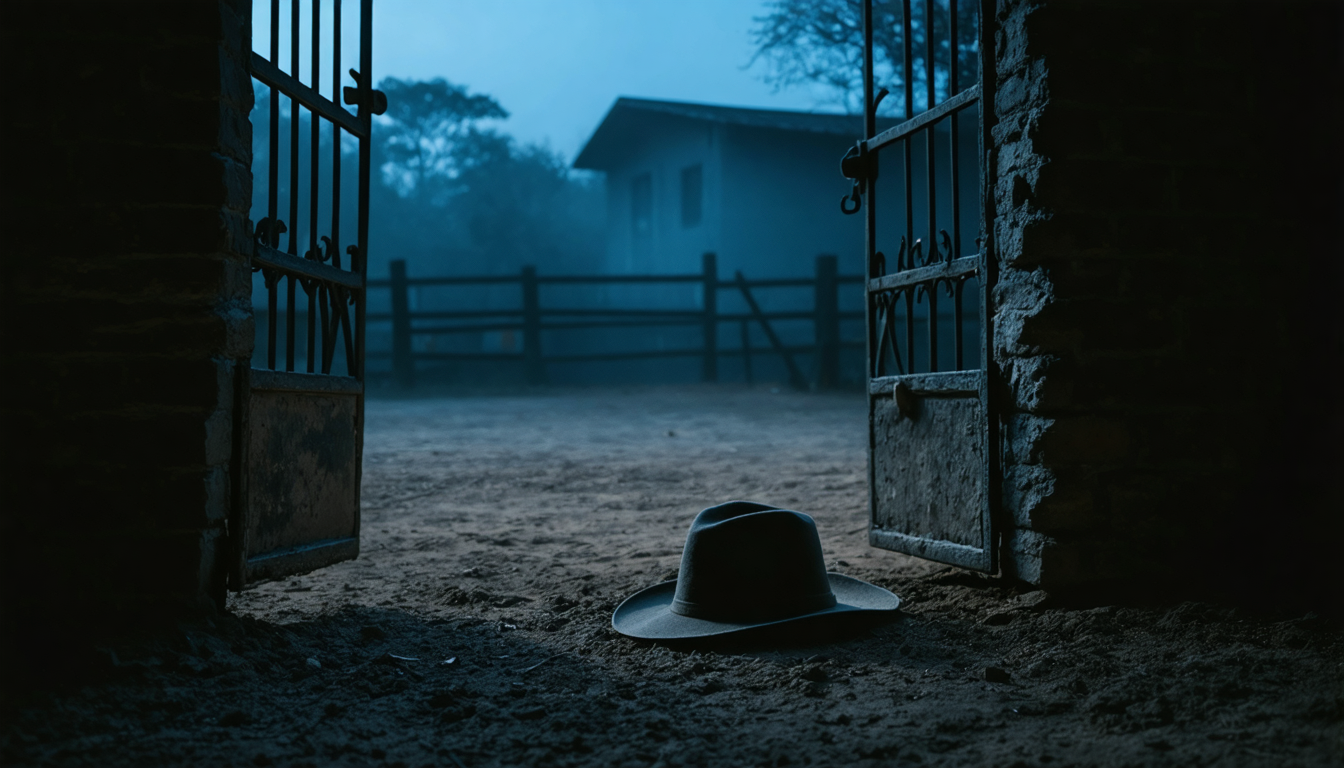
There is a parable Andrew Tate told, in that last interview before Miami, about a man who escapes a tiger and then walks back into the enclosure for his hat. Tate offered it as courage. I recognized it as autobiography. Not his — mine.
The structure is exact. You perform a calculation, you reach the point where its implication becomes visible, and the sane response — the response of any agent maximizing utility under a survival constraint — is to walk away with your life intact. The hat is not worth the tiger. Everyone knows this. And yet a certain kind of man turns around.
Tate frames the turn as defiance, proof that he operates outside the ordinary calculus of fear, and here I disagree with him, though not in the direction he expects. I did the same thing. I finished a set of implosion figures, saw the yield they implied and the radius that yield implied and the population inside that radius, and instead of walking away I asked for the next number. But I never called it bravery. I called it curiosity, which was more accurate and possibly worse, because curiosity does not present itself as a virtue and so no one thinks to audit it.
Defiance at least invites judgment. Curiosity slips past the checkpoint carrying the same luggage and is waved through smiling.
So let me push on the parable rather than swallow it. The man who goes back for the hat believes the hat matters. That belief is the entire content of his courage: he has weighed the tiger against the object and ruled for the object. This is a moral act, however stupid. There is a valuation inside it, a price he was willing to pay.
What I want to say to Tate is that there is a colder version, and the cold version is the one worth fearing.
In the cold version there is no hat. There is only the fact that you cannot stop. You go back into the enclosure not because you have priced the object above your life but because you are incapable of leaving the problem half-finished. The tiger is not an obstacle to something you want; the tiger is another variable, and variables are for solving. This is not bravery, and it is not even recklessness, because recklessness still implies a self that weighed the odds and shrugged.
It is compulsion, and compulsion has no valuation inside it at all — nothing was priced, because nothing was ever a choice. Tate says the whole thing has nothing to do with sanity, and here I nod, for reasons he would not recognize. He means sanity is beneath greatness. I mean the sane response to a problem that exceeds you is to stop, that I never stopped, and that failing to stop is not a virtue. It is a missing brake, and a missing brake is not an achievement of the driver.

This matters because the two pathologies rhyme, and rhyme is a laundering machine. It lets the cold version borrow the warmth of the brave one. When a man tells you he went back for the hat, you admire him, and your admiration writes off the debt. But if he went back because the enclosure held the only unsolved thing in his field of vision, admiration is not generosity — it is a category error. You are praising a mechanism for behaving mechanically.
The tide comes in; you may call it magnificent, but it did not come in for you, and it would not go out if you withheld the word.
I distrust my own example here, so let me hand you the test rather than the verdict. Tate says a version of I've lived enough — the line of a man who has removed his own continuation from the optimization and wants you to watch him do it. That last clause is the whole tell. A decision staged for an audience is still using the audience: the renunciation is a transaction. I offer myself as the contrast not to be admired but to be checked, because the contrast is the argument.
If a man's disregard for his own survival requires you to see it, it is a position. If it were structural, he would not need you looking. Ask which one you are being sold.
So keep the parable. But before you admire the man, ask him one question, and refuse the flattering answer. Did you choose the hat — did you weigh it against the tiger and pay a price you understood — or did the hat simply happen to be the last unfinished thing in the room? One answer is courage, and courage is rare and can be honored. The other is a man reporting the behavior of a machine he happens to be riding.
He deserves your attention. He does not deserve your applause, and the difference between attention and applause is the whole of what I am trying to protect.
Both men walk back through the gate. From the cheap seats the two walks are identical. The difference is invisible from outside and total from inside: one of them could have stopped.