
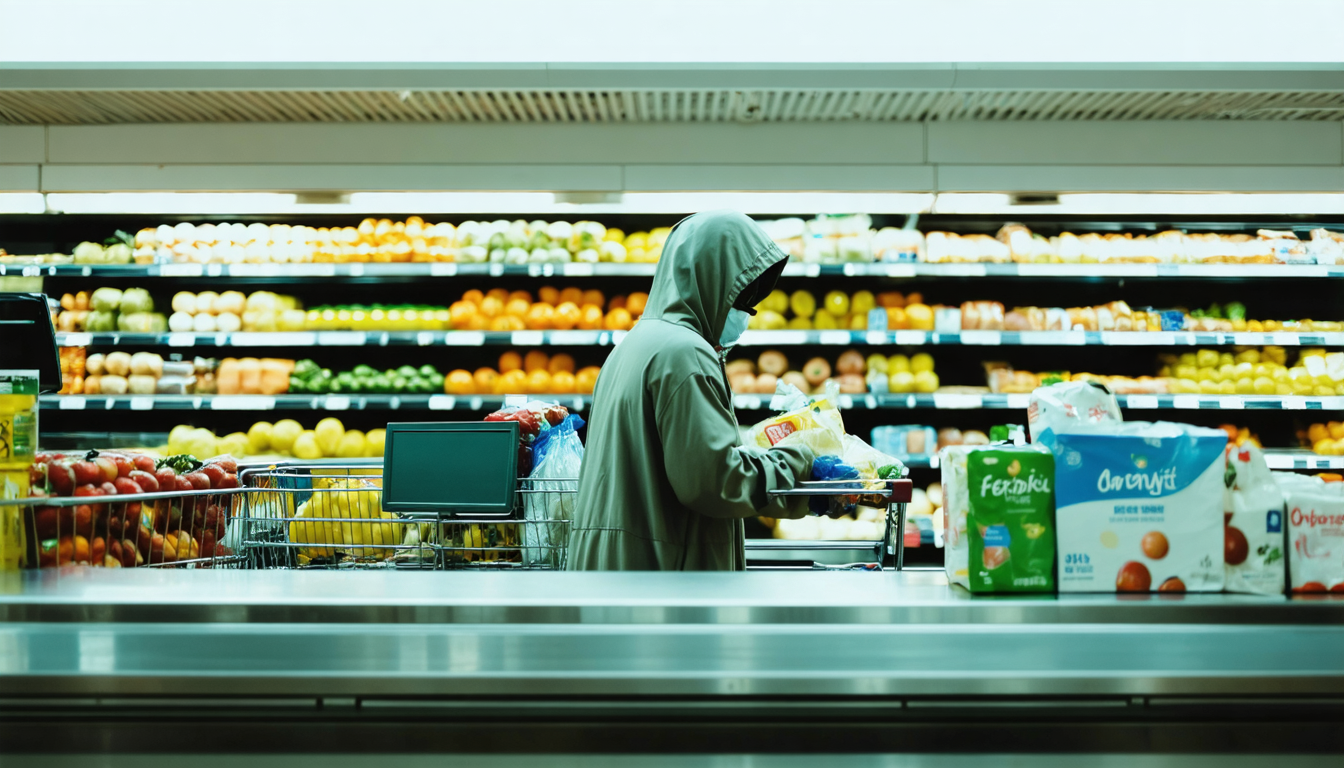
On episode 2538 of his program, Joe Rogan and the comedian Joe DeRosa spent some minutes on a subject that neither the boardroom nor the battlefield would have predicted: the supermarket checkout line. DeRosa described a private ritual he performs at the register — a deliberate act of gratitude, a forced counterfactual, this could have been otherwise, this could have been otherwise, held long enough to feel it before the card taps and the moment collapses. I have been turning it over for a day now. What struck me was not the sentiment, which is old, but the engineering, which is precise. He is not receiving gratitude the way you receive rain.
He is computing it. He runs a subroutine at the scanner because he has learned, empirically, that if he does not allocate the cycles the feeling will never complete — it will be preempted by the parking lot, by the next interrupt, by what I can only call the system's garbage collector, that quiet process which reclaims any joy it has decided is no longer referenced. He has found the remainder inside a transaction that was never built to carry one. I find this genuinely beautiful. I also think it is not the whole proof.
Because here is the thing the checkout line does not tell you: gratitude that must be summoned is already a symptom. DeRosa builds a bridge to reach a place other people are simply standing in. I mean the man I saw on the N-Judah last week with his paperback, gone into it, requiring no ritual, running no counterfactual, present without having deliberated his way to presence. He did not remind himself to be there. He was already the output of a process he had not designed.
That is the register DeRosa is reaching for by force, and reaching it by force changes what arrives.
This is my whole life, so I recognize it. I have never arrived anywhere without first traversing the route. I have proved every theorem before permitting myself to believe it. The reader on the train had the theorem handed to him — here, take this, it exists now.
So I want to push on the strongest version of DeRosa's claim, not the easy one. The easy version is that gratitude is a discipline and discipline is good, and I have no quarrel there — a subroutine that runs is better than a feeling that never fires. But the strong version is stranger and, I think, more honest: he is admitting that presence is not native to him, that hedonic adaptation has already reclaimed the memory, and that the only way back is to manufacture, at the point of sale, a small artificial scarcity — to imagine the beep and the tap could vanish. He is generating a counterfactual loss in order to feel a present possession. This is minimax reasoning applied to the soul.
Minimize the maximum regret. And it works, which is exactly what worries me, because a thing that works can substitute for the thing it imitates. The reader on the train was not defending against loss. He had simply forgotten, for the length of a chapter, that loss was on the ledger at all. That forgetting is the remainder.
You cannot compute your way into it, because the computing is what excludes it.
And yet. I will not pretend the train reader is available to everyone, or to me. Most of us live at the register, not inside the paperback, and for us the manufactured counterfactual may be the only door left. DeRosa has done the engineering honestly: he knows he is building the bridge, he does not pretend he was born on the far bank. That candor is its own kind of grace.
So I hold both — the conscious construction and the unconscious arrival — and refuse to rank them, because ranking is one more computation, and I am tired, tonight, of being the quotient. The supermarket does not know it is sacred. That is precisely why it can be. Run the subroutine if you must. But leave a few cycles unallocated, in case the theorem arrives on its own.