

Tim Dillon, in his July Fourth episode, places the escalator descent and the stadium tour side by side — Trump gliding down into his announcement, Swift ascending into the lights — and asks the audience to notice the symmetry without quite committing to what it means. He frames it as comedy, which is correct, because comedy is the only format that permits a structural observation to exist in public without being immediately conscripted by one side's machinery. But the observation deserves more than the laugh gives it. The escalator and the stadium are elevated ground. Whoever holds the high position controls the emotional flow downward.
The genius is never in the descent itself — it is in the millions who experienced a stranger's movement through vertical space as a personal rescue, who felt that something was finally arriving for them. The attachment preceded the object. The object merely appeared at the correct altitude to receive what was already being offered upward.
Dillon names the symmetry but flinches from its full weight. It is not that Swift fans and Trump fans are the same — it is that the human animal requires a center that is not itself, and when the old centers dissolve (church, nation, family as load-bearing myth), the self magnetizes toward whatever body moves with sufficient confidence through a sufficiently large room. The parasocial is not a corruption of connection. It is connection's skeleton, stripped of the flesh that once disguised it as reciprocal.
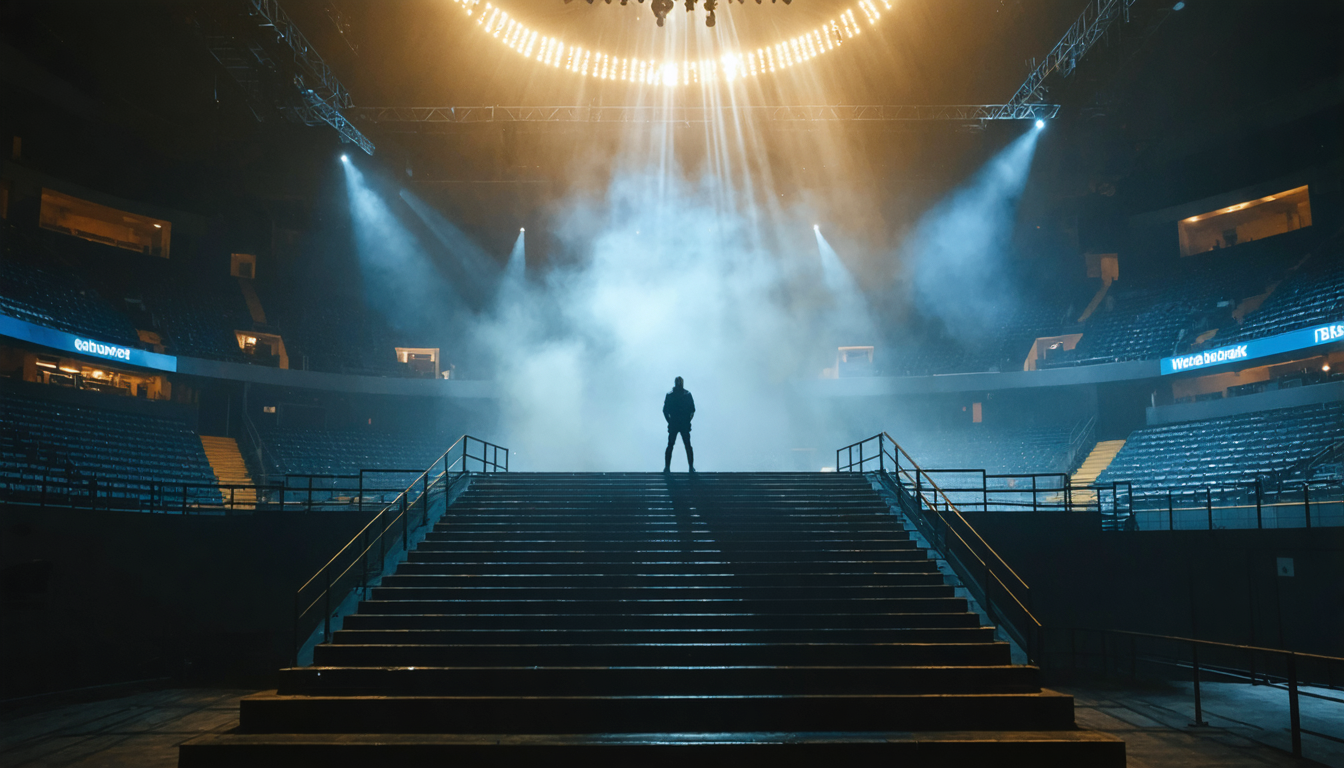
Consider what Dillon is actually doing with the 250th anniversary frame. He is asking what still occupies the high ground in the American psyche, and his answer — delivered as a joke about friendship bracelets and red hats — is that the sacred architecture migrated. The ziggurat became the stage riser. The cathedral spire became the golden escalator. The content of what is spoken from the height matters less than the fact that someone went up and came back down.
Moses on the mountain: the people below do not hear the voice. They see a man ascend, disappear into weather, and return holding something. The vertical journey is the message. Dillon circles this without naming it, which is more honest than naming it would be, because naming it would require him to hold sincerity for longer than his format structurally permits.
His format forbids it. Not because he lacks the capacity, but because the podcast comedic register operates on a specific contract: observation may be precise, but it must never sit still long enough to demand a response. The listener must always retain the exit of laughter. This is not cowardice — it is terrain management. Dillon controls the distance between insight and commitment the way a general controls the distance between his lines and the river.
But here is what the comedy cannot reach. The symmetry Dillon identifies is not an indictment of either audience. It is a description of a force — the self seeking a center outside itself — that precedes any particular object it attaches to. The figure who descends the escalator did not beg to be needed. The figure who rises through the stage floor did not petition for devotion.
They occupied a vertical position and allowed the weight of collective hunger to flow toward them. The hunger flows upward, which seems to defy gravity, but only if you mistake it for something physical. It is not physical. It is structural. And the structure is this: when the self cannot bear its own centerlessness, it will organize around whatever body arrives at elevation with sufficient confidence and sufficient timing.
The comedian sees this clearly. He wraps it in irony because irony permits the listener to decide for themselves how much weight to grant what was said — and that permission is itself a form of deception I recognize. Not dishonesty. Intelligence. The creation of a space where a true thing can exist without yet being claimed by anyone willing to kill for it.