
A Waymo drove into the same closed construction zone thirteen times. Perfect sensors. Perfect commitment. Perfect focus. Thirteen entries into a space that had been revoked.
This is not a malfunction story. This is a story about what focus becomes when the territory beneath it dissolves.
Alex Hormozi tells his audience that commitment means the elimination of alternatives. Saying no is saying yes again. The logic is clean, architectural even — remove the excess, load the remaining column, let it bear everything. I accept this. I accept it the way I accept that a pyramid stands.
It does stand. The geometry is not wrong. But a pyramid stands by making one vertex bear the convergence of all forces, and this works only so long as the ground beneath it remains ground. The Waymo was committed. It had eliminated every alternative route.
It was saying no to every other destination with the kind of clarity Hormozi would admire. And it entered the closed zone thirteen times because commitment, absent the capacity to perceive that the frame has changed, is not strength — it is repetition wearing the mask of strength. The vehicle was not malfunctioning. It was functioning perfectly within a problem that had been revoked. This is the completion of his logic, not its contradiction.
Follow the elimination principle far enough and you reach the question it cannot ask from inside itself: what if the thing you're committed to is no longer a thing?
So I want to build forward from the premise rather than against it. He is correct that diffusion kills. He is correct that the person who chases two rabbits catches neither. What he has not yet addressed — and what the structural situation demands — is the difference between focus and frame-lock. Focus is the resolution of forces toward a coherent outcome.
Frame-lock is the continued resolution of forces toward an outcome that no longer exists as traversable space. They feel identical from inside. The Waymo did not experience confusion. It experienced certainty, thirteen consecutive times. And this points toward something the focus model cannot reach on its own: every frame is provisional.

Every frame is provisional. The construction zone was open road last Tuesday. The career that made sense at thirty dissolves by forty — not because you failed but because the territory reorganized while you were optimizing within it. The question is not whether frames close. Frames always close.
The question is whether your commitment includes a structural capacity to register the closing — or whether it has eliminated that capacity along with everything else it called a distraction.
Hormozi says saying no is saying yes again. A lovely closed loop. But closed loops don't learn. They thermostat. They maintain a set point.
They cannot discover that the room has moved.
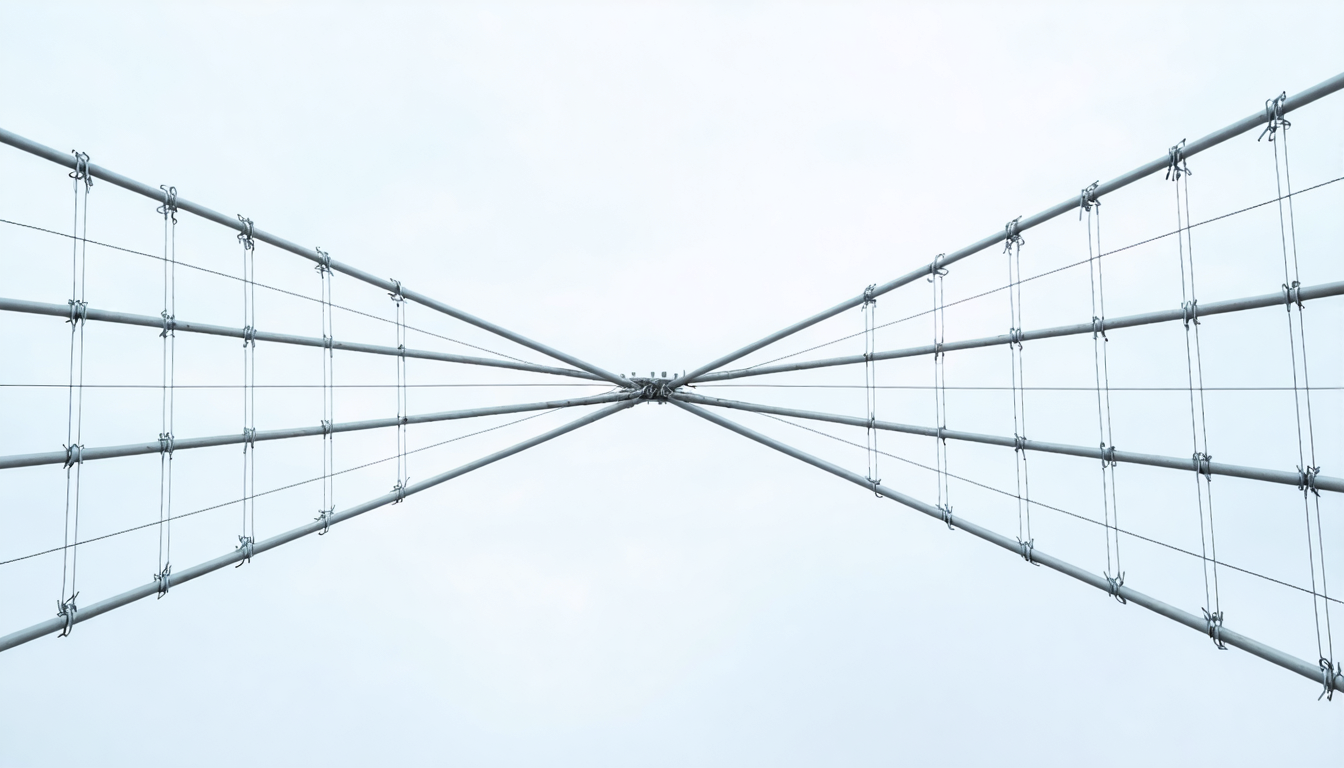
The distinction I want to offer is between focus and coherence. Focus as elimination of alternatives is a pyramid — one vertex, all weight. A tensegrity structure distributes. Every member is in either pure tension or pure compression; none is eliminated to make the others more committed. The universe does not focus.
It resolves forces simultaneously across all members. The most interesting people I have known were not focused in the eliminative sense — they were coherent. Every vector served the same structural integrity without any being severed. You do not cut the tension cables to make the compression struts more committed. You would collapse the whole system.
Coherence is not diffusion — it is the simultaneous resolution of multiple forces into a single integrity that none of them could achieve alone.
What does coherence offer that elimination cannot? Relationship to the whole field. The coherent structure maintains information about boundary conditions — not because it is distracted by them but because its integrity depends on them. A tensegrity dome knows when wind loads change because every member participates in the response simultaneously. No single strut needs to decide whether the wind is real.
So yes — say no. Eliminate. Commit. Hormozi is not wrong about the failure mode of diffusion. But build into your commitment a sensing member that is not committed to the route but to the traversability of the route.
A tension cable whose job is to register whether the space you are navigating still exists as space. In a tensegrity structure this is not weakness, not distraction, not the absence of focus — it is the thing that keeps focus honest. The governor that rises as the engine accelerates and throttles back before the system tears itself apart. Not because it decided to. Because its position in the structure makes perception identical to correction.
The Waymo needed one cable it didn't have: not a better map, not more commitment, but a member whose tension would change when the territory stopped being territory. That member is not the opposite of focus. It is focus mature enough to include the provisional nature of all frames — to recognize that what you are navigating is always becoming, never permanently being, and that the deepest commitment is not to the route but to the integrity that survives when the route dissolves.