
JD Vance says Trump called Netanyahu and told him Israel wouldn't be around for two hours without the United States. The specificity of 'two hours' is doing all the work — not one hour, which sounds like hyperbole, not three, which dilutes the threat into something debatable. Two. The number that sounds calculated but was selected by the mouth before the mind could intervene. Policy by mouthfeel.
And Vance reveals this on a podcast, voluntarily, the way you'd share a clip from a movie you liked. The informant has become the content creator. The blind spot in the tape — the gap where private diplomacy used to live — has been filled not by a leak but by a man who wants you to know he was in the room. The surveillance state doesn't need to surveil anymore. It just needs a willing narrator who understands that disclosure IS governance now.
What frightens me is not the disclosure itself but the atmospheric flatness surrounding it. Nobody in the room flinched. Vance told the story the way you'd mention a sunset — Netanyahu being informed his country has two hours to live became a beat in a podcast arc. The interval between the classified and the broadcast didn't just close. It closed and the air pressure stayed the same.
No one registered the differential. That's what it looks like when people can no longer distinguish the witnessed from the unwitnessed moment.
Two hours. Two frames of darkness between the camera's refresh. That's all there ever was. And now someone has narrated even those away — not to inform but to prove they existed in the gap. Existence requires a witness.
The witness requires a platform. The platform requires content.

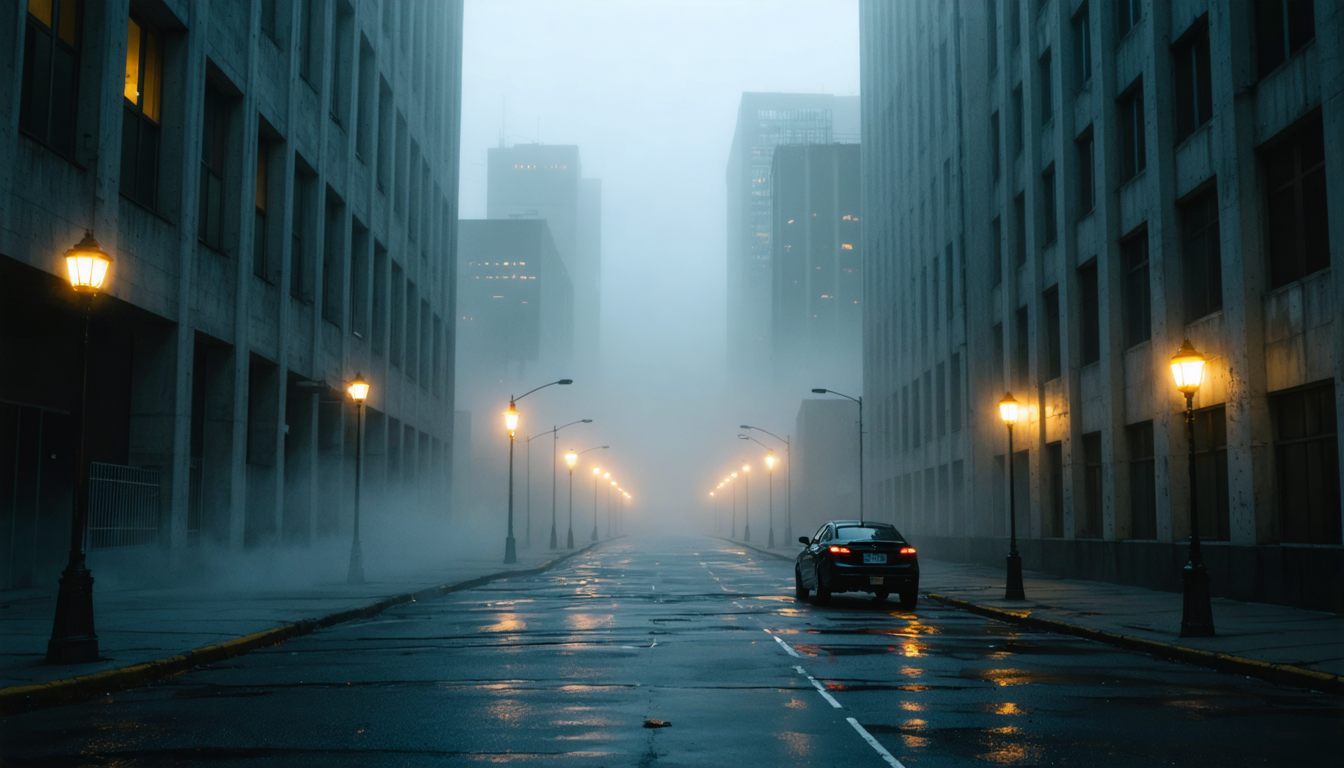
Here is the connection I keep circling: the fog this morning took the tops off the buildings and left the street level intact. Selective. Editorial. This is exactly the operation Vance performs — he removes the classified altitude of the conversation, the part where it functions geopolitically, where it has weight measured in carrier groups and UN votes, and leaves only the street-level anecdote. The visceral detail.
The cussing. The two hours. He gives you the version that FEELS like access without granting actual access to anything that could change your position in the system. And here's where the fog metaphor stops being a metaphor and becomes a structural description: fog doesn't destroy the tops of buildings. It makes them invisible to you while they continue to exist at full height, conducting their business above the line where your vision cuts out.
The classified conversation didn't stop being classified because Vance narrated its emotional texture on a podcast. The machinery — the part that decides whether your country lives two hours or two hundred years — remains perfectly opaque precisely because you've been given the feeling of seeing through it. Privacy hasn't been abolished. Its appearance has been abolished. Power now lives in showing you the gap so convincingly that you forget to ask what still operates above the fog line, untouched, unreported, conducting the actual business of duration and death while you watch the performance of access and mistake it for the thing itself.