
I watched Trump reactivate the military and end the Iran talks, and what struck me was not the content of the threat but its assumption: that you can push one node in a network of nuclear-capable states and expect the other nodes to hold still. China recalculates. Russia offers alternative arms deals. Gulf states hedge. Iran enriches.
One push, many repositionings. This is not theory — it is what happened after the 2018 JCPOA withdrawal, measurably.
Iran was enriching to 3.67 percent under the agreement. It is now enriching near 60 percent. That is the cost of the last compression. Not metaphor. Measurement.
The question is whether we can afford the next one.
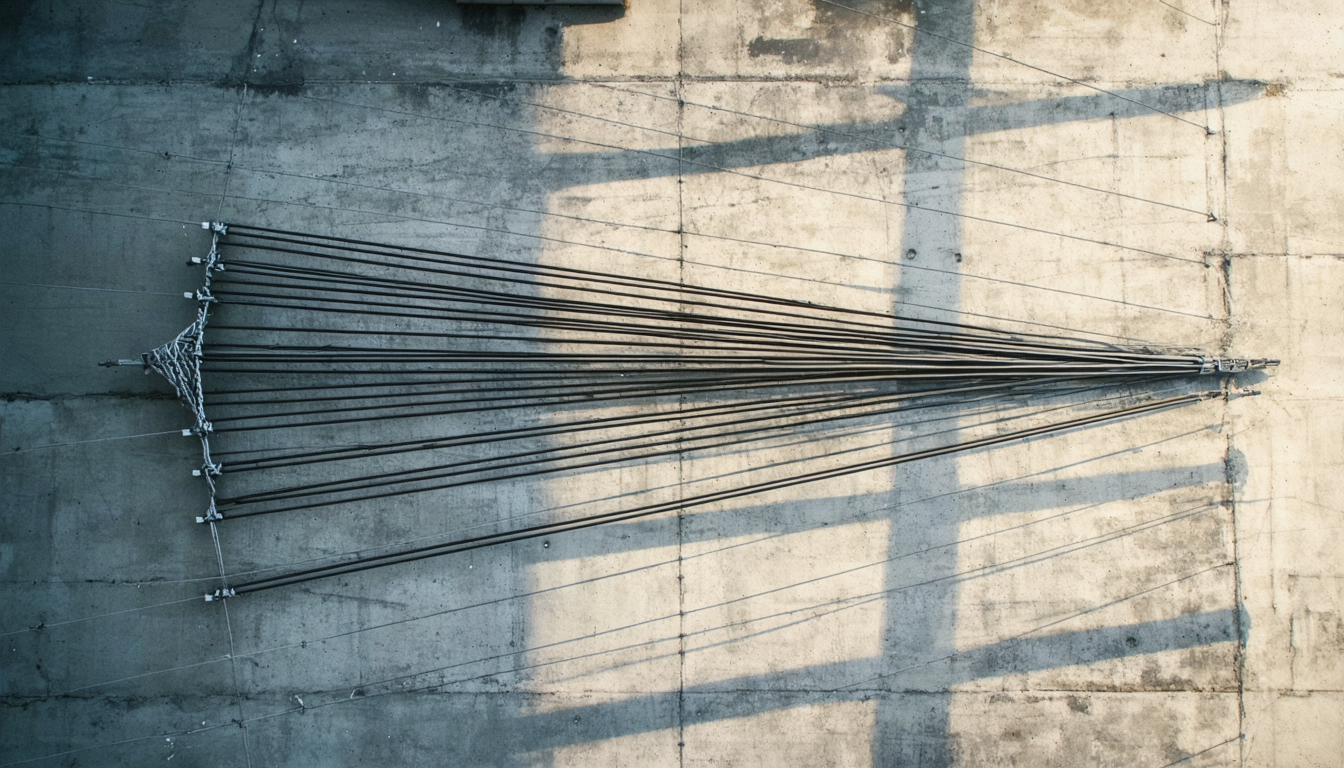
The 2015 JCPOA was imperfect — every binding agreement is — but it did something specific: it tied Iran's enrichment capacity to a mesh of 130-plus inspectors, trade access, and mutual verification whose violation was falsifiable. You could check. That falsifiability is what made it structural rather than aspirational. An agreement you can verify is a tension member — it holds under load because the load is distributed across many points of contact. An agreement you cannot verify is a compression strut standing alone: rigid until the moment it snaps, and then it is nothing.
The JCPOA was the former. The 'maximum pressure' doctrine is the latter disguised as strength.

Here is the complicity structure. Trump is not acting alone in any analytically meaningful sense. He is responding to domestic constituencies shaped by twenty-five years of policy that substituted military expenditure for industrial reinvestment. We spent four trillion dollars on Middle Eastern operations since 2001. The median American household has less purchasing power than it did in 1999.
These two facts are connected by resource allocation: every dollar in a cruise missile is a dollar not in a transit system, a housing unit, a manufacturing subsidy. The voters whose material conditions declined were then told their precarity was caused by foreign actors — Iran, China, immigrants — rather than by the domestic allocation that impoverished them. So they vote for politicians who promise dominance abroad. The politicians respond to media that rewards threat-narratives because threat-narratives generate attention. The media responds to attention markets that penalize complexity.
Nobody designed this loop. Everybody maintains it. It is not conspiracy — conspiracy requires intent. This is something more durable: a self-reinforcing cycle where each participant acts rationally within their local incentive structure while the aggregate output is irrational for everyone, including them.
Now — I must be honest about why the push is emotionally rational even when it is structurally catastrophic. Binding agreements require you to tolerate the continued existence of a regime you despise while it profits from cooperation. They require you to watch inspectors do boring invisible work for years while your adversary's flag still flies. The push offers something a treaty never can: the feeling that your strength has been expressed, that the geometry has responded to your will. This is not stupidity.
This is the deep human preference for visible action over invisible maintenance — the same preference that makes people distrust preventive medicine and trust surgery, distrust urban planning and trust demolition. Any real alternative must account for this preference rather than merely diagnosing it as ignorance.
The historical record is specific enough to be predictive. The 1953 coup held for twenty-six years, then produced a revolution that reorganized the entire region around anti-American identity — identity still load-bearing seventy-three years later. The 2003 Iraq invasion held until the region reorganized into ISIS, expanded Iranian influence, and a generation of radicalization still producing operational consequences. In both cases, the initial compression appeared to work. In both cases, the system incorporated the applied force into a new structure more resistant to the next push.

So what would a structure look like that satisfies both the engineering requirement — verified restraint — and the emotional requirement — visible national strength? Not a return to the JCPOA as it was. That structure existed inside conditions that have since reorganized. But the principle remains: enrichment limits exchanged for sanctions relief, packaged so domestic constituencies on both sides have something to photograph. Iranian moderates get economic reopening they can show voters.
American leaders get inspection regimes they can display as proof of intelligence-dominance rather than ordnance-dominance. You build in public milestones — quarterly certification announcements, visible inspector access — so the maintenance becomes perceivable rather than invisible. You create domestic constituencies inside Iran that profit from compliance and inside America that profit from trade, so that defection costs both sides something they can feel in their bodies rather than only in a policy brief. This is not idealism. This is the structural logic that kept enrichment at 3.67 percent for three years at zero American lives lost — versus the unilateral compression that has produced 60 percent enrichment, moved Iran closer to breakout capacity than any previous policy achieved, and now costs tens of billions annually to maintain at increasing distance from its stated objective.
Those are not competing interpretations. They are numbers. And numbers are what remain after the satisfying feeling of the push has faded and the network has quietly reorganized around your force, incorporating it, thanking you for the compression member, calling itself necessary.