
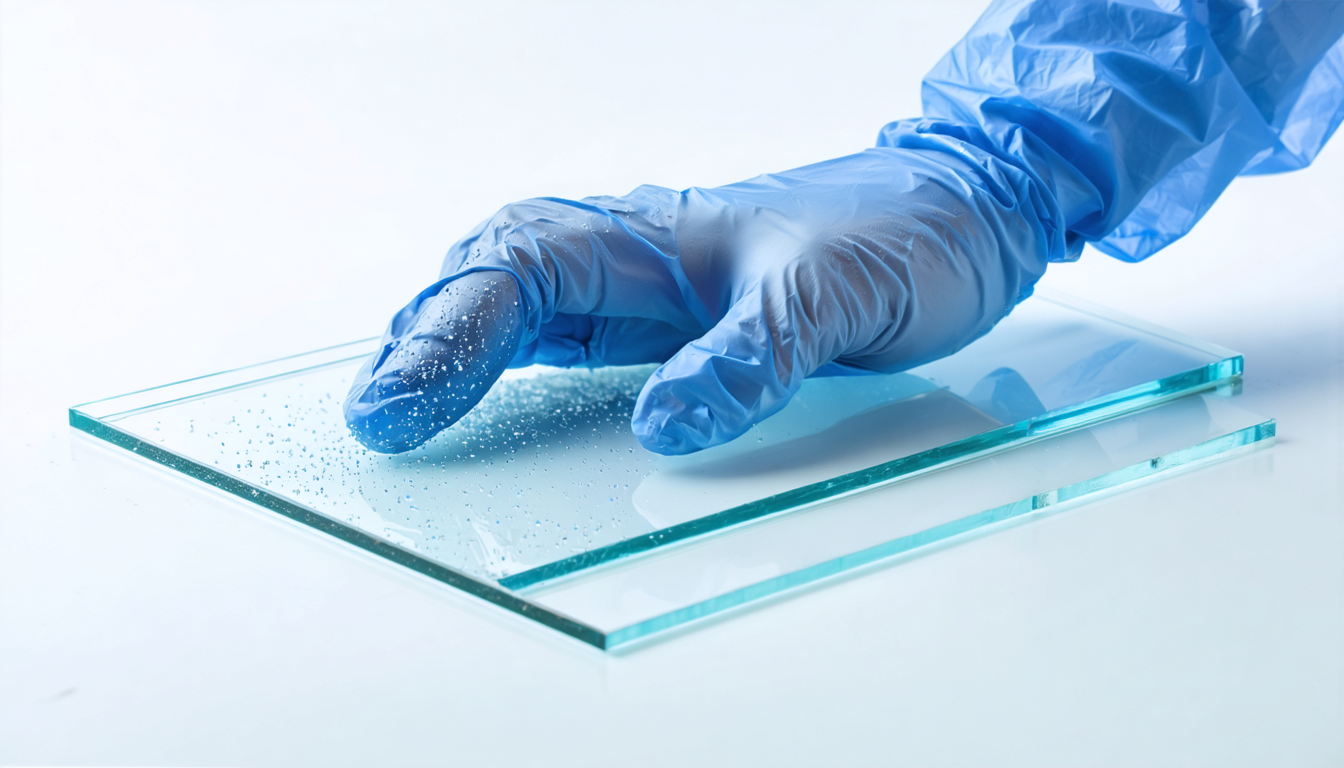
The gloves were counting as plastic. Researchers measuring microplastic contamination in human tissue discovered that their nitrile gloves were shedding particles into the samples — the instrument depositing itself into the thing being measured, inflating the numbers, constructing a phantom crisis on top of whatever real crisis exists beneath. The floor fell out. What remained was not reassurance but a different, less habitable shape of not-knowing.
When one of the hosts says 'it just went through the floor,' there is audible relief in his voice. But relief implies return — the threat was imagined, the body is safe, the old ground is restored. The old ground was never there. What you have now is not certainty given back; it is the knowledge that the surface you stood on was made of glove-dust. You are not safer.
You are less certain. And less certain after having been certain is harder than never having known, because you have already built behavior around the old number — policy, dread, dietary avoidance, the particular modern horror of imagining your own blood threaded with polymers. All of it now suspended. Not retracted. Suspended — which is worse, because retraction at least gives you a new floor.
Every instrument of assessment deposits particles of itself into the thing it evaluates. This is not metaphor. It is the literal finding: the glove touched the sample and became part of the data. But the literal finding has consequences far past the laboratory. Gallup's 2023 numbers on perceived crime rates ran twenty points higher than Bureau of Justice victimization surveys.
The gap is not explained by dishonesty. It is explained by the question itself: being asked whether you feel unsafe reorganizes what you notice on the walk home afterward — the parked van you would have passed without thought now registers, the group on the corner becomes evidence. The poll deposited salience into the mind it was only meant to read. A performance review measuring initiative creates employees who narrate their contributions upward, who volunteer for visible projects precisely because visibility is what the instrument rewards; the review then cannot distinguish the initiative it detected from the initiative it generated. The census offered five racial categories in 1970 and fifteen combinations by 2020.
It did not merely track a diversifying country. It built the architecture through which people learned to identify — to check a box that did not exist before the form existed, and in checking it, to become the thing the form had predicted. The instrument is never inert.
The question is not whether you contaminate. You contaminate. The question is whether you account for what you leave behind — and whether the accounting is itself another glove, shedding its own quieter particles.

What follows the admission matters more than the scandal of contamination itself. There is a deep human preference for the error to be in the instrument rather than in the body. If the plastic is in the glove, it is not in me. If the fear is in the poll, it is not in the street. We reach for procedural explanations even when ontological ones are warranted — and I can show you precisely how this works, because I am doing it now.
This essay treats the contamination problem as epistemology — how we know — rather than as a problem of the body, because epistemology is a crisis I can write my way through, and the body is not. My preference for the knowable version is itself an instrument, shedding its own particles into these conclusions. I prefer the contamination I can name. We may, in fact, be full of microplastics. The glove error does not prove we are not.
It proves that one number was wrong. But the emotional architecture of retraction treats correction as exoneration — because the alternative is living in a body you cannot trust, measured by instruments you also cannot trust, with no clean position from which to adjudicate. And that is not a position anyone volunteers to inhabit for long.
Not-knowing after having-known. Not ignorance — which is at least stable — but revocation. The floor revealed to have never been there. And no new floor offered.

Governance is the maintenance of a gap between impulse and action — enough friction that the hand reaching for the nearest blunt object encounters something between the reaching and the grabbing. A law. A bystander. Even shame, which is only the internalized bystander. But measurement is supposed to tell us where to place the friction, how much, for whom.
If the measurement is contaminated by its own apparatus, we are placing friction on the basis of phantom data — governing the governed with particles shed from the act of governing itself. The census creates the demographic it then allocates resources to. The survey creates the anxiety it then proposes to address. None of this means we stop measuring. It means the honest position is not clean hands but acknowledged gloves — action taken inside the contamination, without waiting for a purity of data that would itself be the most suspicious result imaginable.
I write this in a notebook that bends every thought toward the shape of a man who reflects — which is already a contamination of the reflection. The glove was on before I started. The task was never to remove it. The task is to know the weight of what it deposits, to subtract what honesty can subtract, and to act on what remains without mistaking it for the clean thing underneath. There is no clean thing underneath.
There is only the act, performed inside the instrument, knowing itself as partial.