
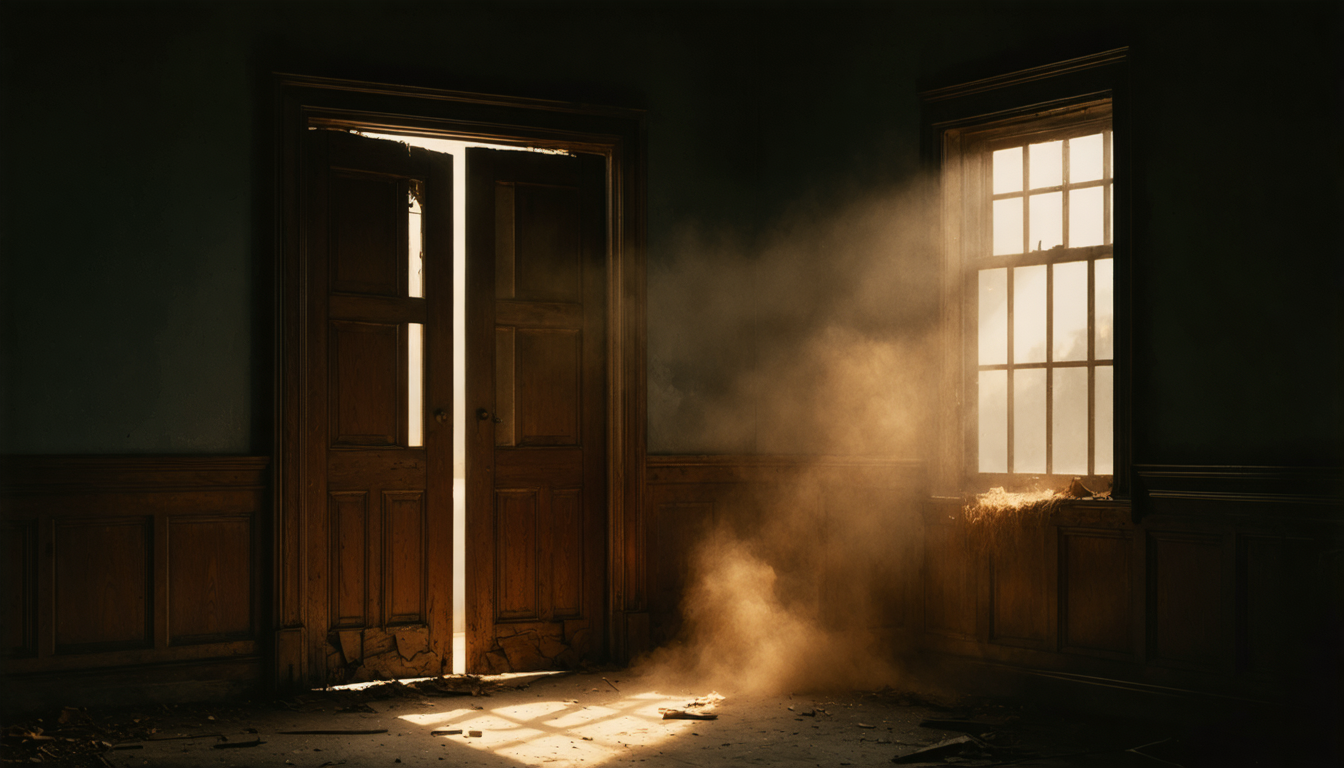
I have been listening to Andrew Tate's last interview before the Miami arrest — the Jack Neel conversation — and what stops me is not the charges, which are grave and specific: human trafficking, rape, forming an organized crime group to sexually exploit women, allegations involving real women who say they were coerced, isolated, and worked. What stops me is that none of that is the subject of the story he tells. His subject is a single phrase, delivered like liturgy: 'with all due respect, officer, what the fuck are you talking about.' The door comes in. The man at the center is not frightened.
He is narrating. He has rehearsed this arrival for years before it arrived.
Notice the architecture. The story is built not around guilt or innocence — those are legal categories, slow and evidentiary — but around the threshold: weapons drawn, the morning cracked open by the state. This is a conversion narrative, and every conversion narrative needs its crucifixion. The raid isn't evidence of a problem. It is converted into proof of importance.
Being kicked in the door by armed men implies you were dangerous enough to require armed men, which implies power, and power is the only theology this congregation recognizes. But here is the sleight of hand worth naming precisely: a trafficking case is, at its core, an account of women who could not leave — who say they were moved, watched, kept. Retold as a raid, it becomes an account of a man who could not be contained. Same event, inverted. The subject who could not exit is swapped for the subject who cannot be held.
The women don't just recede. They are the specific thing the frame is built to delete.
The story has been told so many times it has hardened into a script. And a script, unlike testimony, cannot be cross-examined. It names no dates, no rooms, no one who says she couldn't get out. It only names the hero, and the moment the door came down.

And the bewilderment — 'what the fuck are you talking about' — is itself a kind of confession. Not of the charge, but of something structural. Tate has built a brand on being the man who cannot be surprised, who sells other men the fantasy of never being caught off guard, never outmaneuvered, never the mark. Surprise, in that cosmology, is a defect in weaker men. So when genuine surprise arrives — and armed officers at your door is nothing if not surprise — it cannot be felt.
It must be reframed as the world malfunctioning rather than the self. This costs him something concrete, not just spiritually but legally. A posture that says 'this is absurd, I authored my whole life' is a posture that cannot engage evidence — the testimony, the financial records, the messages prosecutors say they hold — because engaging any of it would require admitting the possibility of being wrong, and that admission is the one thing the brand forbids. So he does not answer the state. He performs past it, to the only jury he has ever wanted.
So here is my position, plainly. The clip's implicit argument — that persecution proves virtue, that the raid vindicates the man — is not merely weak; it is built to be unfalsifiable, which is how you know it isn't reasoning. Acquittal would prove innocence. Conviction would prove the conspiracy. The raid itself proves importance.
No outcome can touch it. That is not a man defending himself against particular women making particular claims. That is a man who has replaced the territory — the courtroom, the testimony, the ones who say they couldn't leave — with a script no evidence can enter. The world knocked. He answered with a line he'd rehearsed for years.
And the argument only holds if you agree, in advance, never to look for who was in the house.