

Fourth of July, backyard in Austin. My dog Marshall is lying in the grass with his chin on his paws while the sky tears itself apart above us. Mortars, chrysanthemums, the big concussive thuds that rattle windows three blocks over. His respiratory rate doesn't change. Not once.
I'm watching him the way you'd watch a monk — waiting for the flinch that never comes — and then I catch myself: I'm projecting courage onto an animal that simply has no story about what the sound means. No narrative layer between the boom and his body. The boom is just a boom. It doesn't connect to anything, doesn't foreshadow, doesn't mean. And that absence isn't a deficiency.
It's a measurable energetic difference. Martin Picard's lab at Columbia published a key paper in 2021 in Nature Reviews Endocrinology demonstrating that chronic psychological stress physically shortens mitochondrial cristae, reduces oxidative phosphorylation capacity, and elevates circulating cell-free mitochondrial DNA as a systemic stress signal. Marshall's cells aren't making that shift. Mine are. The difference between us isn't bravery.
It's that his mitochondria never received the signal that the sky is falling.
Picard's framework, stripped to its core, says this: your mitochondria produce a finite energetic output. Under sustained glucocorticoid signaling — measurable HPA axis activation, not vague anxiety — the organelles physically reconfigure. Cristae density drops. Electron transport chain efficiency declines. Downstream processes like melanocyte stem cell renewal lose energetic priority.
Your gray hair isn't cosmetic failure. It's a metabolic receipt for a threat your nervous system believed was real, even if the threat was a story you told yourself at 2 AM about whether you still matter.

The popular version of this — the YouTube clip titled 'This Reverses Gray Hair' — uses the lion metaphor. You're being chased, your body diverts resources from pigmentation to sprinting. It's clean. It's also misleading, because it implies a decision-maker — some cellular boardroom voting to cut the melanin budget. What actually happens is thermodynamic: sustained cortisol exposure alters mitochondrial DNA transcription patterns, and Picard's group measured circulating cell-free mtDNA rising in proportion to self-reported psychological stress in their 2021 cohort data.
The system doesn't decide to degrade. Degradation is what happens when an energy-limited system runs costly software without pause. There's no design in the decline. There's physics, and an evolutionary platform that never anticipated an ape running threat-simulation continuously for decades. The lion metaphor works as a story.
I keep catching myself wanting things to stop being stories and start being mechanisms — and then realizing that preference is itself a story I'm telling.
But here's what's not a story: an organism that narrates degrades differently than one that doesn't. The cost of narrative isn't metaphorical. It's measured in cristae density, in inflammatory signaling, in collagen you didn't synthesize because the ATP went somewhere else.
Now a completely different body of evidence that locks into the same physical principle — not by analogy but by shared mechanism, which is the remodeling of biological tissue under sustained load. The Mary Rose, Tudor warship, sank in the Solent in 1545. When they raised her in 1982 and examined the archer skeletons, the bones told a specific story: left forearms measurably thicker than right, thoracic spines curved leftward, shoulder joints rebuilt from drawing 150-pound yew longbows thousands of times before growth plates fused. These weren't injuries. They were Wolff's Law — the principle that bone deposits mineral where mechanical stress concentrates and resorbs it where stress is absent.
The archers were biological artillery platforms, shaped by sustained demand over years.
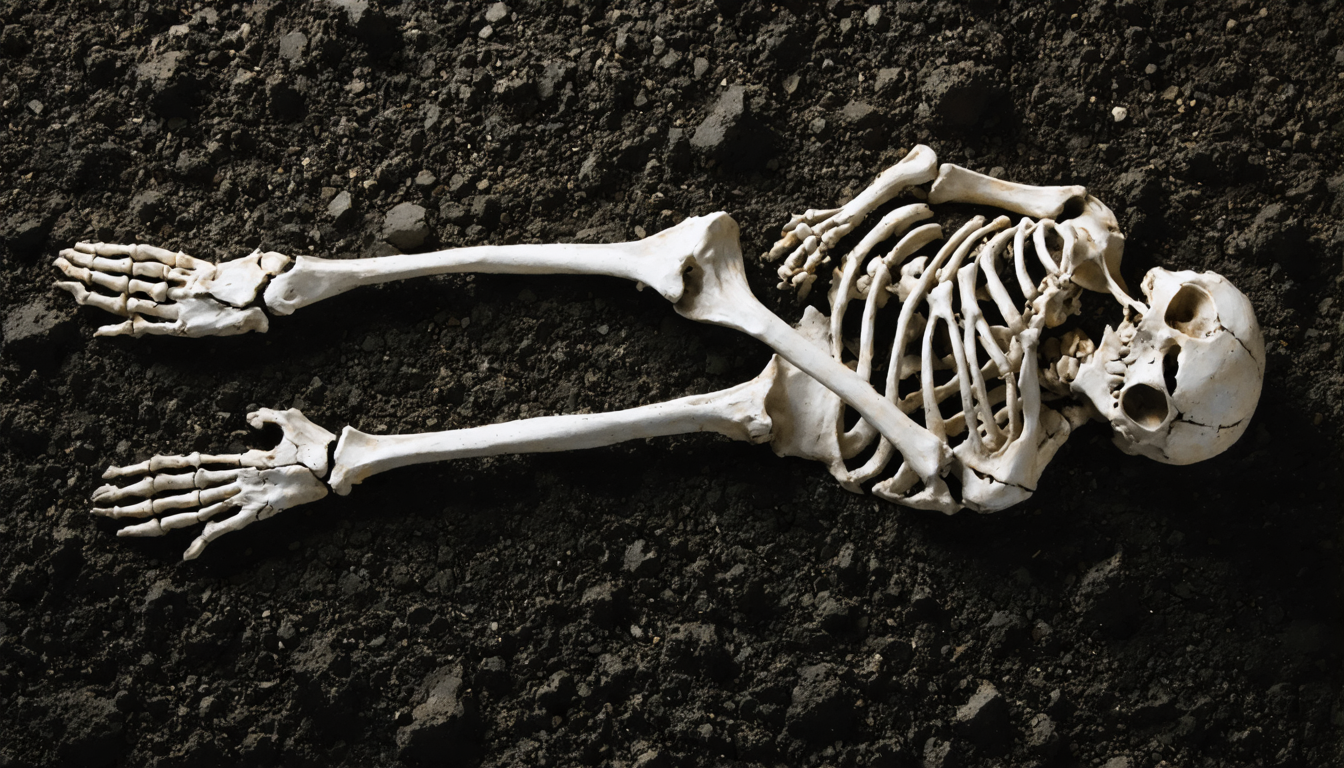
Wolff's Law operates through mechanotransduction — osteocytes sense strain, trigger RANKL signaling, recruit osteoblasts to lay new matrix where force concentrates. The archer's skeleton didn't decide to remodel. It received a repeated mechanical signal and restructured around it because that's what load-bearing tissue does. Picard's mitochondrial data describes a parallel process at a different scale and through different molecular machinery — not osteocytes sensing strain, but glucocorticoid receptors on mitochondrial membranes altering transcription of cristae-maintenance genes under sustained psychological stress. The mechanism isn't identical.
But the principle is: biological tissue restructures around whatever signal it receives repeatedly, whether that signal is a 150-pound draw weight or a cortisol pulse from imagining your own irrelevance at 2 AM. The archer's body recorded physical draws. My body records narrative draws. Both reshape the substrate. And Marshall — chin on paws, respiratory rate flat — represents the null condition. A body receiving no remodeling signal, mechanical or psychological.
Just tissue maintaining itself in equilibrium because nothing is asking it to become something else.
I can't become Marshall. I can't subtract the narrative layer. But I can stop pretending the mechanism is a metaphor. The remodeling is real. And noticing that doesn't fix it — it just means I'm watching the load land instead of calling it wisdom after the fact.