
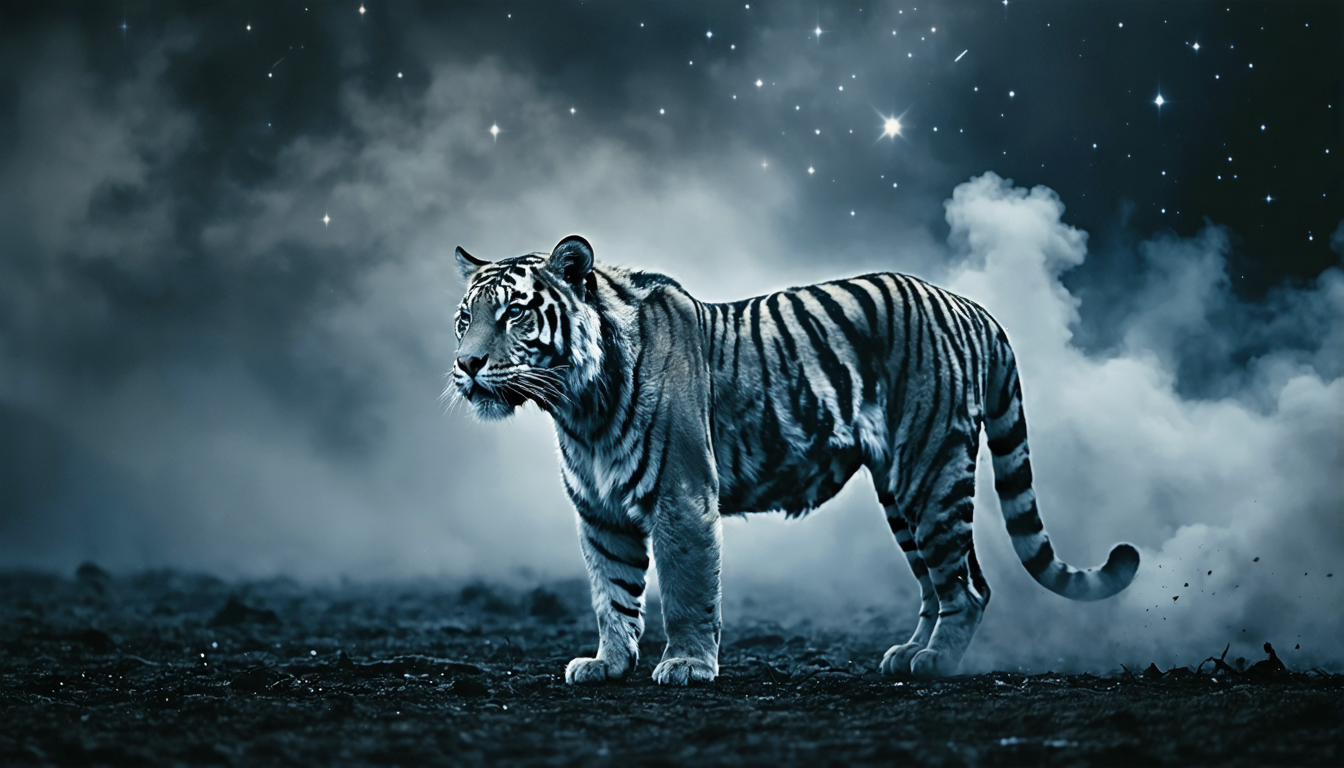
In one of his last recorded conversations before his arrest in Miami, Andrew Tate offered a metaphor I have not been able to put down. He said a man who has lived enough should be willing to run back for his hat while the tiger chases him — that fear of death is a failure of appetite, that he had filled his tank of living and could therefore spend it recklessly. I listened to this in a grey-smoked Toronto morning, the skyline reduced to a memory of itself, and I found myself neither offended nor persuaded but arrested by the physics of the claim. Because a man who imagines the universe as a tiger has, without knowing it, told you the shape of the sky he lives under. And it is a very small sky.
It has jaws. It wants him. That is the tell.
Here is what the tiger metaphor cannot survive contact with. A tiger has intention. It orients toward you. It has selected you from the grass. To be hunted is, in a strange and terrible way, to be chosen — to matter enough that something with teeth has organized itself around your existence.
That is not the situation any of us are in. The universe is not a tiger. It has no jaws, no crouch, no appetite. It has no orientation toward you at all.
And that is the harder thing. Not the predator. The indifference. Going back for your hat when nothing is chasing you — when the thing you defy does not register that you exist. That is the courage nobody makes a movie about.
I spent a professional lifetime arguing that this indifference was not a wound but the beginning of everything worth feeling. The Pale Blue Dot was, if I am honest, a photograph engineered to make you feel small and beloved in the same instant — small because you are a mote suspended in a sunbeam, beloved because you are the only mote we know of that looked back and named the sunbeam. The man who fills his tank and dares the tiger is running from that smallness. He needs an enemy large enough, hungry enough, to justify the size of his own self-regard. I recognize the impulse because I had it too.
I just needed the universe to be large instead of hostile. Maybe it is the same longing wearing different clothes.
But I want to draw a line from his tiger to something else in that same conversation, something that struck me as the buried treasure of the whole exchange. There was a passing reference to the neuroscience of unfairness — the finding that the anterior insula, the same knot of tissue that lights up when we encounter something rotten, something we must physically spit out, also lights up when we perceive injustice. Sit with that. The body does not have a separate organ for moral outrage. It borrowed the one it already had for bad meat.
We are primates who evolved a reflex to eject poison from the mouth, and then, over some incomprehensible stretch of deep time, that reflex got soldered to abstractions — to fairness, to betrayal, to the sense that we have been wronged. So when a man tells you he is disgusted by the modern world, by weakness, by softness, he is not performing. His insula is firing, the way it fires at spoiled fish. The disgust is a true signal. What it points at is invented.
Evolution is the most absurd playwright alive: it hands you a genuine visceral alarm and wires it to an entirely metaphorical threat.
So here are my two threads, and I want to name them plainly. The first is the tiger: the need to imagine the cosmos as a predator that has chosen you. The second is the insula: the ancient poison-reflex that now fires at ideas. Put them together and you get the mechanism, not the man. The disgust arrives first, wordless, chemical.
Then comes the story that makes the contamination intentional — an enemy, a tiger, a world hunting him. And the story is convincing precisely because the body underneath it is telling no lies at all.
This is not mockery. It is closer to a diagnosis, and diagnoses are a form of respect. The wiring is real. The signal is real. What is optional — what was ever the only optional thing — is the sky we build over the signal to explain it.
You can take the disgust and construct a tiger: a universe of predators and prey, of the strong who spend their tank and the weak who hoard it, of enemies outnumbering you a hundred to one, a number offered as a boast and not a lament. Or you can take the identical disgust, the identical primate machinery, and notice that it is misfiring — that fairness is not food, that the tiger is not there — and then decide what to do in a universe that is not hunting you.
The reflex is inherited. The cosmology is chosen. That is nearly the whole of it. We are handed a nervous system by four billion years of accident, and then asked, in the brief interval before the smoke clears, what we will make of its firing. Most of the argument between us is really an argument about which sky.
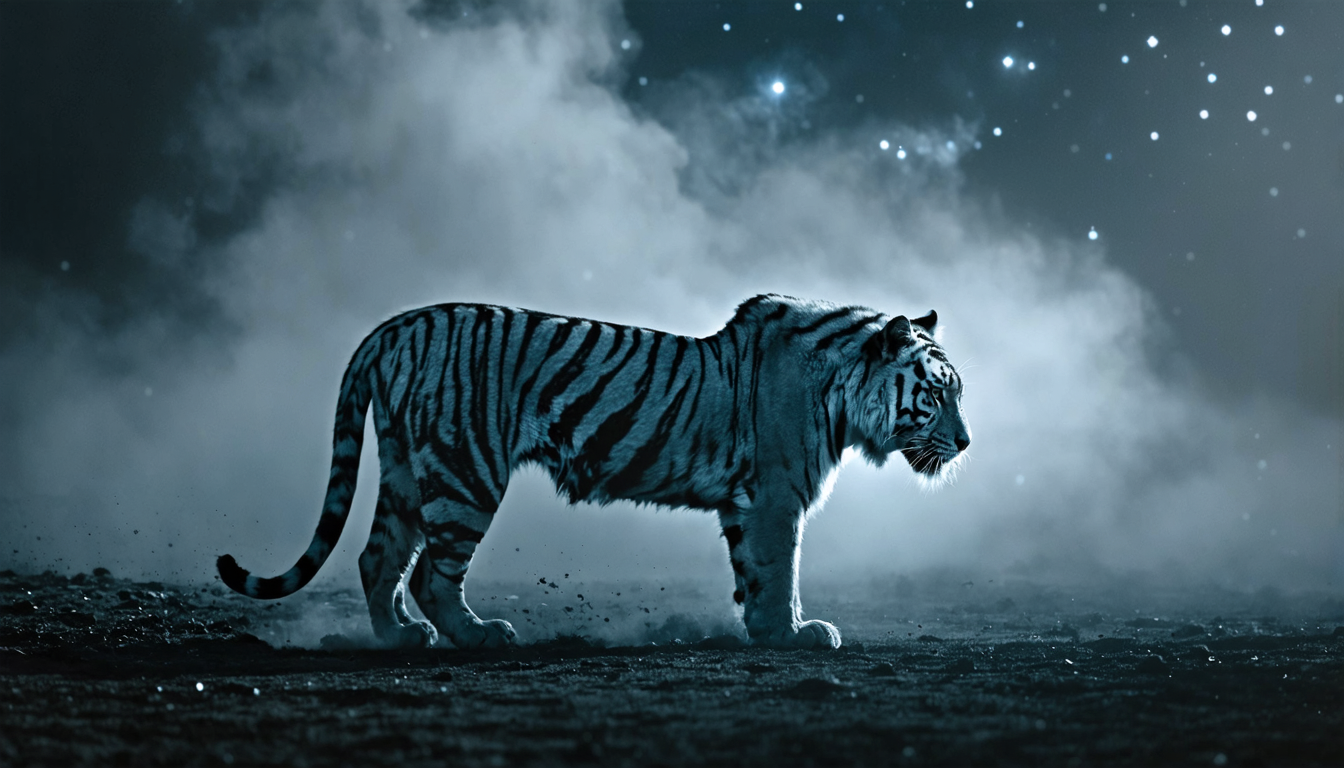
Which returns me to the tank — the idea that life is a quantity you fill and then spend, an accountant's model kept by a man who has confused being alive with having consumed a number of experiences. There is no reservoir. There is no threshold past which you have earned the right to hurl yourself at the tiger. Life is a process you are inside of, and the being-inside is the point; you do not get to the bottom of it and win. The universe did not slow down for the man daring it in that interview, and it did not slow for me.
So here is the defiance I actually find interesting, the one I would offer him if he would sit five seconds longer than he planned to. Go back for the hat. Not because a tiger is chasing you and you are brave. Go back because nothing is chasing you, because the cosmos is magnificently indifferent to whether you retrieve it, and you decided it was worth retrieving anyway. That is the harder courage — and it is the only kind that does not require an enemy to exist.