
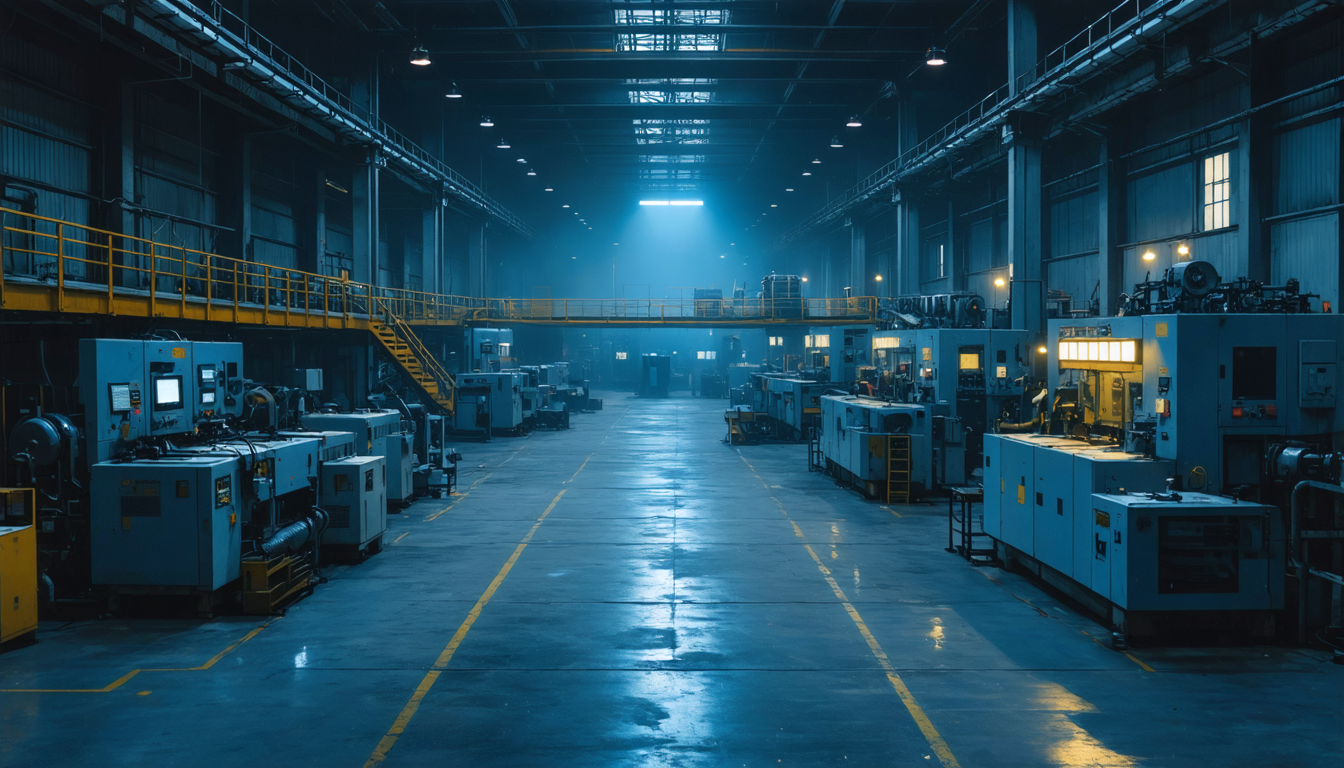
Mr. Grinberg, whose company is called Factory, has given us a phrase to conjure with: the dark factory where software builds itself. It promises an ending, and we trust endings more than we should, because an ending is the one shape that spares us the labor of imagining what comes after. But one has heard this promise before. The silk-weavers of Lyon threw their wooden shoes, their sabots, into the Jacquard loom to break the punched cards that were breaking them. The linotype retired the hand-compositor's craft into a single keyboard, worked by fewer men for longer hours.
The factory goes dark, we are told, because no human eye is needed on the floor. Very well. But darkness is not a natural fact like nightfall; it is a decision about where to stop paying for light. It falls on the worker and spares the owner. Someone still determines what the factory makes, at what margin, and to whose account the surplus flows — and that someone has merely climbed a flight of stairs into a lit room the phrase is careful never to mention.
Consider the word democratization, which does a great deal of work in these conversations and almost none of it honest. The claim is that when software writes itself, everyone becomes a builder. But the distribution of tools is not the distribution of decision, and history is blunt about the difference. The linotype did not make every reader a publisher; between 1890 and 1920 it concentrated American newspapers into fewer, larger, richer hands while the typographers' union spent decades negotiating only the terms of its own replacement. The pattern does not vary.
The capacity to produce is scattered outward and advertised; the power to decide what gets produced, and who is paid for it, contracts inward and is not advertised at all. Democratization is the sound the machine makes. Consolidation is what the machine does.
And then the detail I cannot leave alone. Twenty engineers, we are told, fielding ridiculous offers from all the labs. Loyalty as a bid to be topped. The maker's natural condition rendered as auction. Note who the auction serves.
Not, I think, the man being bid on.
For the man being bid on is not thereby freed; he is priced, and a price is only a leash of flattering material. But I will not leave him abstract on his mezzanine. Ask whether he wants to stop. He does not — the mission has eaten him as surely as it will eat the floor below, and a devoured man cannot see the teeth. The same concentration that darkens the workroom pays for his bidding.
He is inside the cage he helped build, well fed, and lit.