

There is a phrase circulating on a podcast I watched the other night—the episode was titled "Two Ex-CIA Officers Clash Over China, Israel & Surveillance," though the clip I saw contained no clash whatsoever, only two men explaining, with the grave tenderness of clergymen, how you might keep your family safe. The phrase is "commo plan." Communications plan, if you insist on plain English, but they do not insist, because the whole seduction depends on the abbreviation. A family communications plan is a fridge magnet. A commo plan is tradecraft.
And in the compression from one to the other something is smuggled across the border: the suburban kitchen becomes a theatre of operations, the school run becomes an exfiltration route, and you, the listener who owns a phone and a set of car keys, are quietly promoted to the rank of operative in a war you had not previously been told was happening.
"You know exactly where they're going to be," one of them says of his children. It is meant to reassure. It does the opposite. It is the sound of a man converting love into logistics because logistics is the only dialect in which he was ever taught to feel safe.
What interests me is not whether they are right—earthquakes happen, so do shootings, and a family that has agreed on a meeting point is better off than one that has not. What interests me is the flavour of the certainty on offer. The commo plan does not merely prepare you for chaos; it reclassifies chaos as adversary. The earthquake and the gunman are handled under the same protocol, which means nature and malice have been made operationally identical. This is the professional deformation of the intelligence officer mistaken for wisdom: everything is a threat actor, the world has intentions, and the universe, far from being merely indifferent, is out to get your particular children on your particular Tuesday.
It is a strangely consoling worldview, because a hostile universe is at least a universe that has noticed you. Indifference is the one thing the ego cannot forgive.
And here is where the kitchen table meets the canal wall in my mind. Because I have heard this cadence before—the intensity that stands in for evidence. Not in Langley. In Dublin.
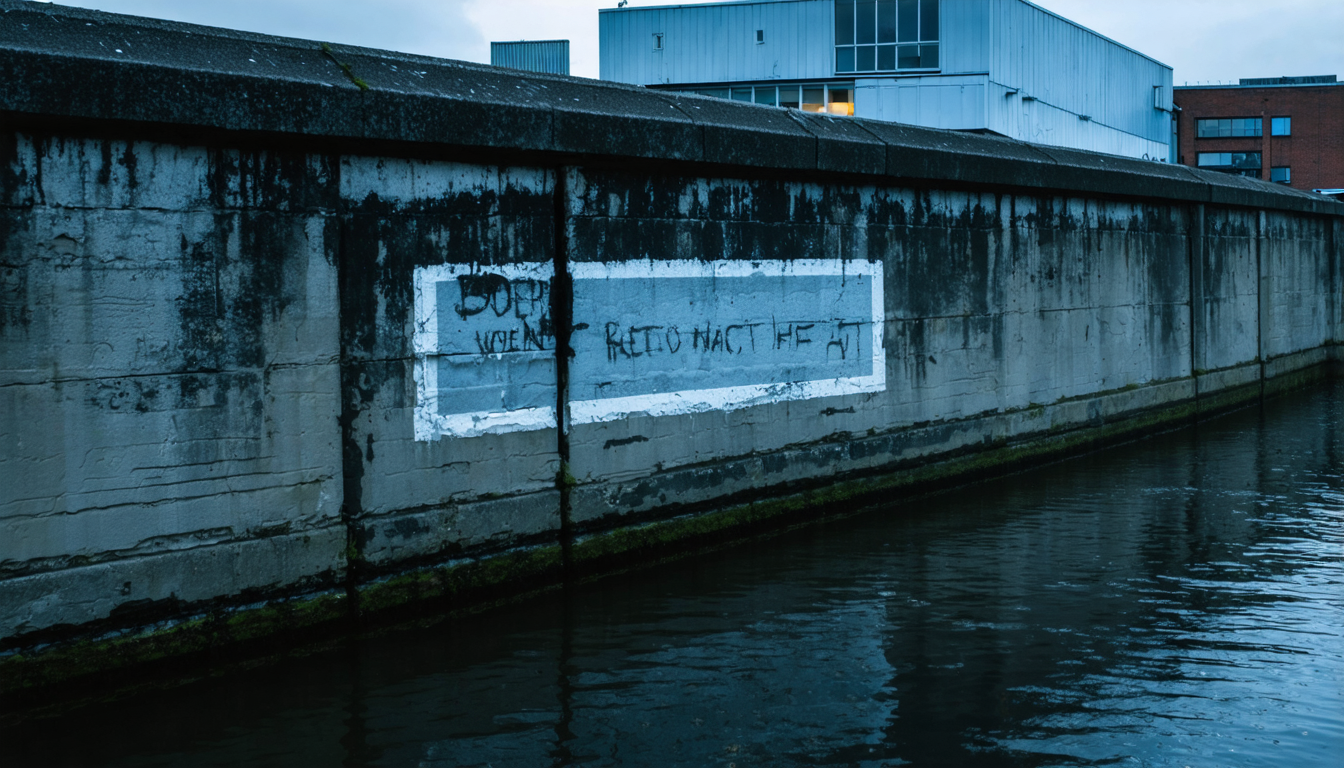
The temptation, and I feel the pull of it as I write, is to say these are the same gesture. They are not, quite, and the difference is the whole point. The ex-CIA officer reaches for the uncountable because he must: there is no earthquake pencilled in for your Tuesday, no gunman assigned to your particular children, so the threat has to be inflated into an atmosphere, a permanent adversarial weather, before the commo plan can justify itself. HOMES NOT HOTELS, the stencil that keeps appearing on the wall near me and keeps being painted over, has the opposite problem. It reaches for a moral absolute when what it actually possesses is a number—a devastating, boring, entirely countable number of vacant units and homeless families and rents that would have bought a house in Crumlin in 1993.
The activist's strongest weapon is arithmetic, and the slogan lays it down for the register of the sublime, the beyond-measurement, the feeling that must exceed the figure. So both distrust counting, and the shared distrust means opposite things: one flees a number that does not exist, the other flees a number so large it should have ended the argument years ago and somehow never does.
Which is the part that ought to frighten us, and does not. The commo plan will keep selling because dread flatters, and being flattered feels like being told a secret. The stencil will keep going up and coming down because righteousness needs no result to renew itself. But the figure on the canal wall was true, was always true, and lost anyway—not to a stronger argument but to the general preference for the feeling over the fact. The other player never called the bluff.
The other player, it turned out, had gone home to the damp.