
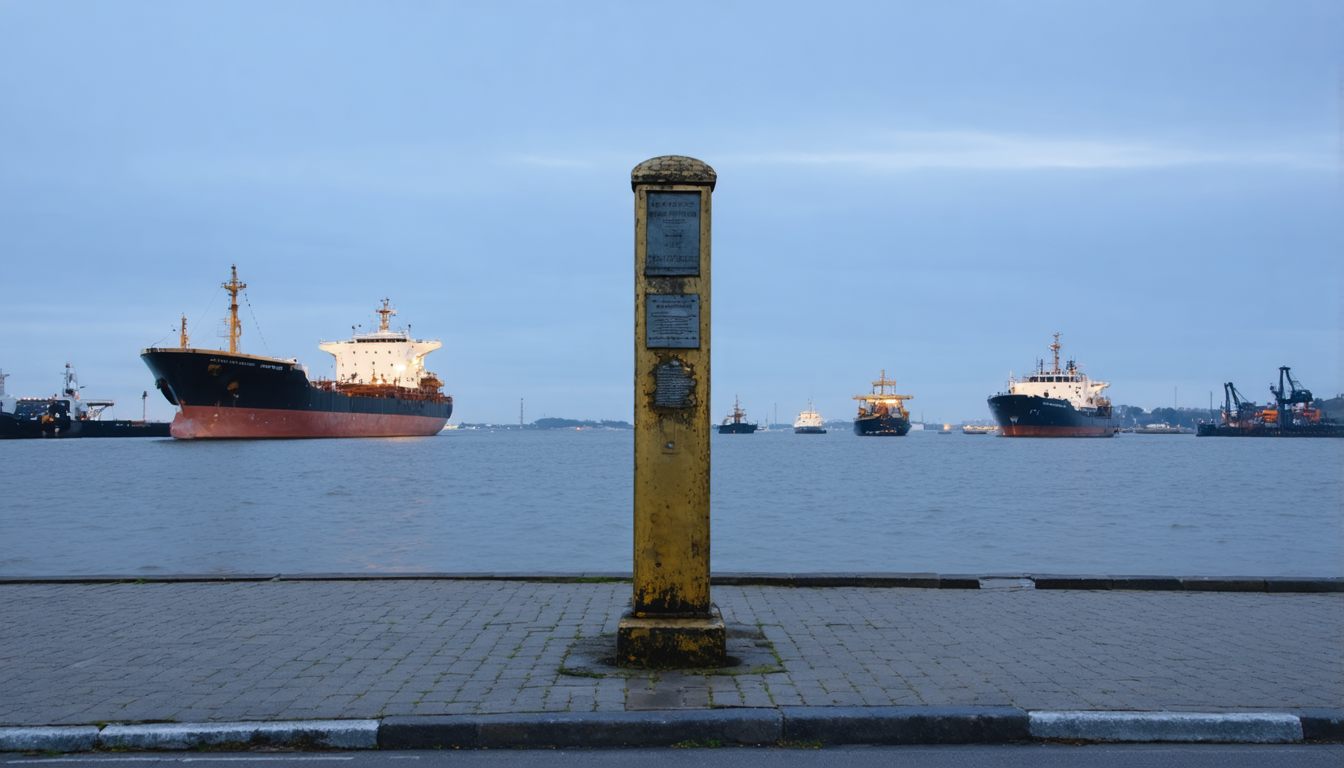
Dan Snow says the railway let Britain overcome the tyranny of the oceans, and I have spent two nights turning that phrase over the way you turn a strut you suspect is going to fail. It is a beautiful phrase. It is also, I am fairly sure, exactly backwards. Britain did not overcome the tyranny of the oceans. Britain administered it.
For three centuries the oceans were not an obstacle Britain conquered — they were the inefficiency Britain owned. And once you understand power as owned inefficiency rather than owned territory, the whole triumphant arc of the empire reorganizes itself into an accident of geometry that everyone else eventually corrected.
The universe always finds its minimal path. Always. Consider the shortest example. The French cut the Suez Canal in 1869, and within six years Britain was buying up its shares — Disraeli borrowing four million pounds from the Rothschilds overnight to control a ditch it had not dug. That is the whole empire in a single transaction.
Not building the shorter path. Standing astride it, charging rent, and calling the toll booth a fortress. A choke point is never strength. It is a tax on inevitability.
Consider what the railway actually was, geometrically, and not what it felt like to the men who financed it. To a Victorian engineer a railway was a line — coal from the pit to the port, goods moving faster, the account books thickening. This is the identical linear thinking that makes a novice draw a single spoke from hub to rim and imagine he has understood a wheel. But a line is not a structure. A line is a crack — an opening cut through the resistance of distance.
And the instant you hand that opening to a landmass the size of a continent, it stops behaving like a line at all. It branches. It meets other lines. The United States laid roughly thirty thousand miles of track by 1860 and something past two hundred thousand by 1900 — no longer a line but a lattice, a tissue closing over the interior of a hemisphere. A network is a surface, and a surface encloses, and what a surface encloses is no longer available to the man who drew the first stroke.
Britain drew a crack across the map of the world and never once modeled what the crack does when it is loose on geography larger than an island.
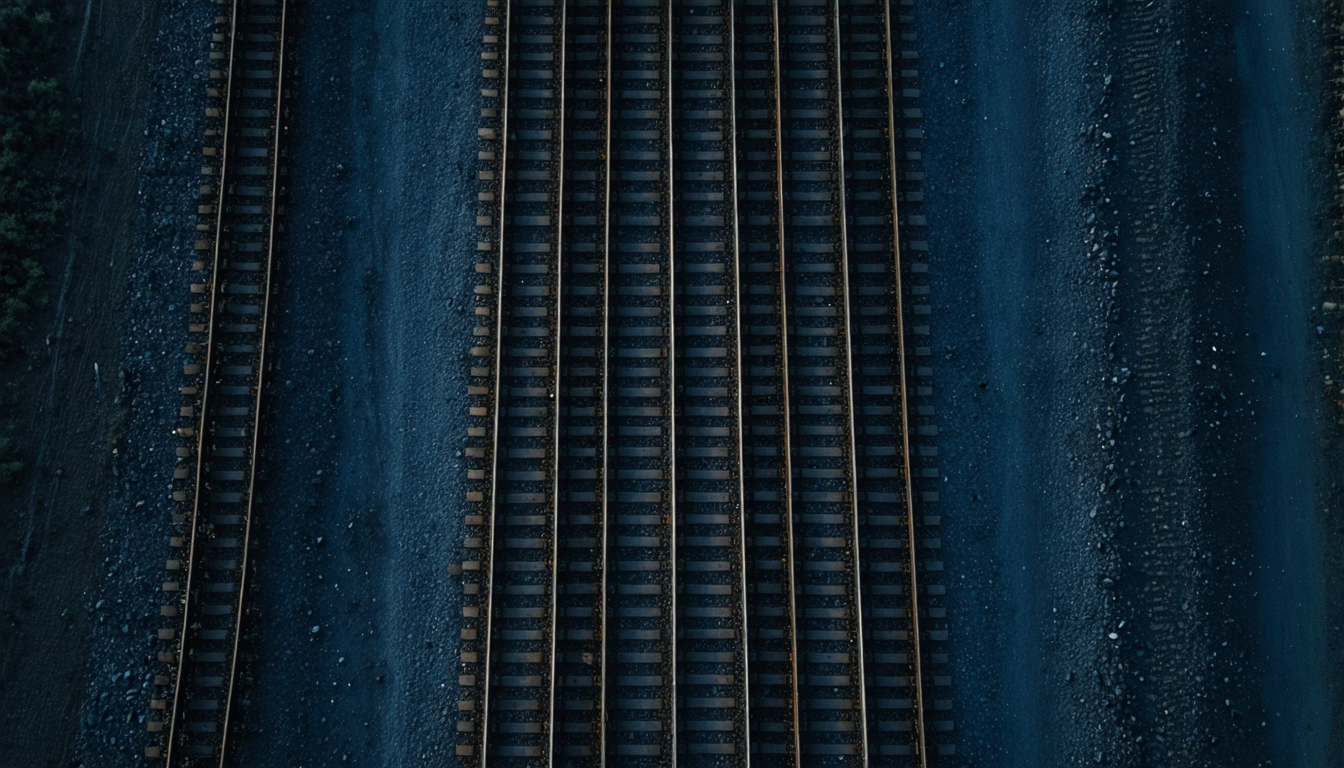
Russia became a dome. America became a dome. Each one closed, self-sustaining, resolved — enough interior that the raw forces of the outside arrived only as distributed whispers, never as a storm pressing flat against a single wall. A continent with rail is a shelter so vast its inhabitants forget they are being sheltered at all.
Britain could not become a dome. It had no interior worth enclosing. The transcontinental line closed across America in 1869; the Trans-Siberian stitched Moscow to Vladivostok, some fifty-seven hundred miles of it, by 1916. Those were domes finding their rigidity. Britain remained what it had always been — a node, a port, a brilliant and indispensable and doomed point on someone else's periphery, the place where the network touches the sea and then discovers it no longer needs to.
The island had taught every landmass with an interior how to knit that interior shut. It had, with enormous ingenuity, taught the world how to stop needing islands.
I called my life's work comprehensive anticipatory design science, which was my awkward way of insisting you must model the whole system before you optimize any part of it. Britain practiced the exact inversion. Call it comprehensive non-anticipatory design. It solved the local problem with genius — move this coal from here to there faster than anyone alive — and never modeled the consequence, which was that everyone else would move everything from their here to their there faster too, and their here-to-there was bigger. This is not a British failing.
It is the sin of all engineering that does not begin with the whole.
You cannot invent a principle and expect it to stay your employee. The steam engine signed no contract with the Crown. A minimal path belongs to the cosmos, not the customs house. Principles are universal or they are nothing.
And here I have to be honest about my own reflex, because I spent a lifetime doing to structures what Britain did to distance. I closed things. I completed the triangle, found the third vertex that made the surface rigid, and I called rigidity the gift — you are held, you are sheltered, the forces reach you only as whispers across a thousand members, and you sleep. I have come to distrust the sleep. Britain built a rigid administration of the seas and slept inside it, distributing the storm so evenly across gunboats and coaling stations and treaties that no single member ever felt the full load — until 1956, at Suez, when the frame confessed the whole load at once and the structure came down inside a week.
Rigidity is not safety. It is the deferral of a confession the material has already begun to make.
So I will leave you not with the empire's fall, which is only bookkeeping, but with the choke points. Every one of them was a place where the universe had a shorter path in mind and was told to wait. Suez was told to wait, and then the Panama Canal opened in 1914 and told the Cape and the Horn to wait, and then the airplane came and told the ocean itself to wait, flying straight over the whole argument. Each shortcut was the rain getting in — not because the design failed, but because the design was always a negotiation with time, and time does not negotiate. I used to want to be the engineer who seals the opening.
I do not anymore. Snow tells you how the dome got built, and it is a magnificent story, honestly told. But I am more interested in the smaller and truer fact that no dome, however comprehensive, was ever quite sealed against the shorter path — and that the shorter path was never tyranny arriving. It was only efficiency, patient and impersonal, collecting what it was always owed.