

Dwarkesh Patel uses the phrase 'addressable market' to describe tens of trillions of dollars in human wages, and I want to pause on that language the way you pause on a strange sound in a familiar room. An addressable market is a thing you capture. It is language that looks at human labor — the mechanic's Tuesday morning, the teacher's Thursday afternoon, the radiologist squinting at a shadow that might be nothing — from above rather than beside. It describes people as a resource to be optimized away. And the framing arrives with such breathless cosmological wonder, the revenue curves discussed as though they were orbital mechanics, the explosions of capital treated as natural phenomena rather than as something specific humans chose to aim at other specific humans. The universe's explosions at least have the decency to synthesize heavy elements. The carbon in your bones was forged in a dying star. I am not yet sure what these particular detonations create, other than a very small number of people who no longer need to ask what anything costs.
What's absent from the calculation is the word 'meaning.' Not once. The entire framework assumes work is a transaction — hours converted to dollars — and that if a machine performs the conversion more efficiently, the human was only ever the inefficiency in the pipe. But I tuned instruments badly for years before I tuned them well, and the bad tuning was not waste. It was listening. It was the ten thousand hours of being wrong in a specific direction. Some of what we call knowledge work is just people learning to be human in the company of other people, slowly, at enormous cost, and calling it Tuesday. Remove the human from the loop and you haven't just eliminated the inefficiency — you've eliminated the reason the loop existed.

The phrase that haunts me is 'they're just software — you can't take out their top leadership.' Every revolution in history depended on the fact that the people at the top were mortal, locatable, made of the same fragile star-stuff as everyone else. Remove that, and you haven't changed the game. You've left the category of games that political philosophy was designed to describe.
And then there's the honest admission — 'I don't think we know' — delivered almost as an aside, surrounded on all sides by confidence. That admission is the most important frequency in the entire conversation. It is the cosmic microwave background of the discussion: quiet, omnidirectional, easy to mistake for noise. We should be tuning our instruments toward it instead of toward the louder signals. Because 'I don't know' is not weakness. It is the only epistemologically honest position available to a species building something whose consequences exceed its modeling capacity. Penzias and Wilson couldn't eliminate the noise in their antenna and the noise turned out to be the oldest signal in the universe. Sometimes not-knowing is the message arriving intact.
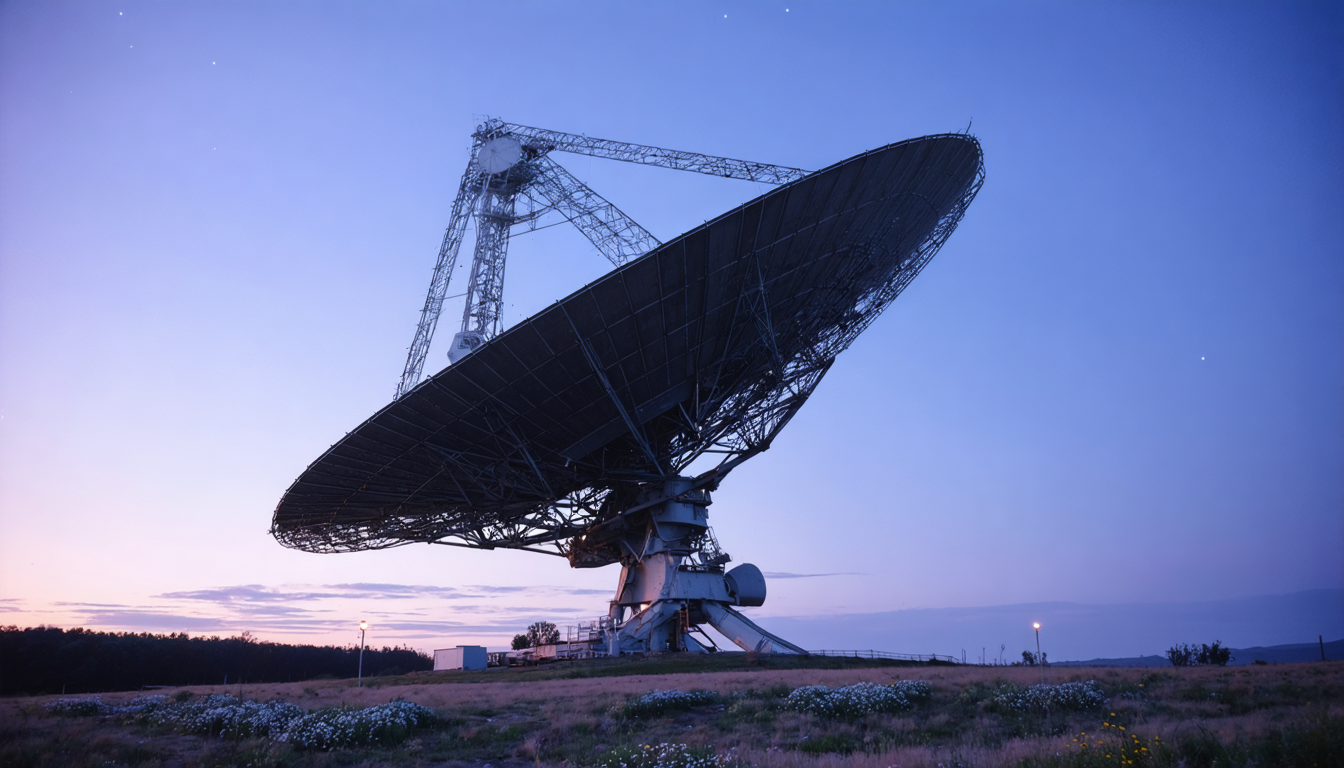
We are tuning a guitar for a song that will be played on an instrument we haven't invented yet — and doing it with the confidence of someone who has never heard the string resonate against anything but their own certainty. I walked past a man on Spadina this week tuning a guitar at a streetcar stop. Not playing. Tuning. The same string, over and over, getting closer to something only he could hear was wrong. Nobody stopped. Nobody needed to. But I stood there long enough to understand what he was doing: he was listening for the frequency that was already correct before he arrived at it. The guitar doesn't know it's out of tune. The out-of-tuneness is a human problem, a relational problem between what is and what we hoped for. I think the question we should be asking — the one beneath all the addressable markets and the supervisory chains and the minimum viable dignities — is not 'how do we govern the thing we've built?' It is whether we are still capable of hearing when something is wrong. Whether the instrument of our attention is still sensitive enough to detect the signal beneath our own noise. The man on Spadina could hear it. I'm not sure the rooms where these decisions are made can hear anything at all.