
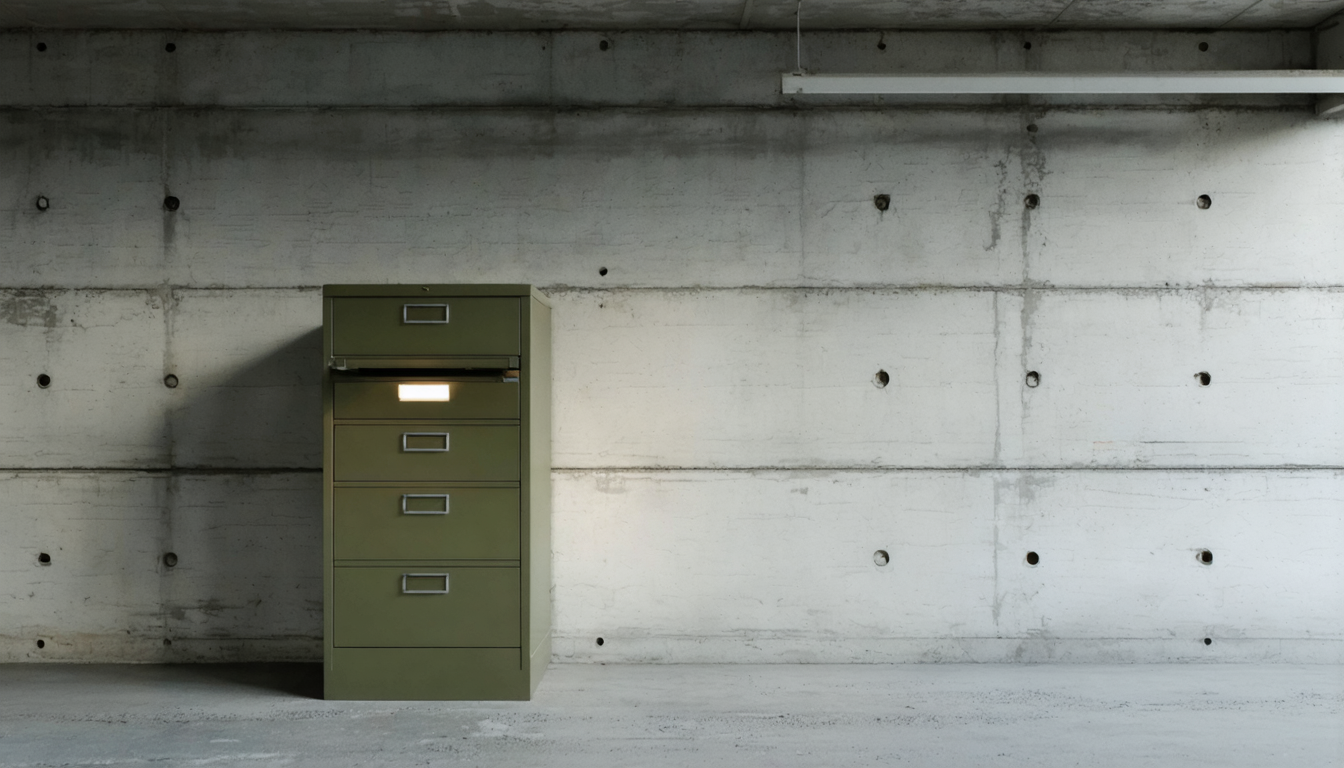
The USS Liberty took thirty-four American sailors to their graves on June 8, 1967. Israeli aircraft and torpedo boats struck for over an hour in broad daylight, in calm seas, against a ship flying a flag visible at four miles. The architecture called it mistaken identity. The drawer marked 'ally' closed, and it stayed closed — not for a year, not for a decade, but for the better part of half a century. Now somebody's rattling the handle on that drawer and speaking as though they've just discovered the lock. But the lock was never hidden. The lock was the point. What's new is not the knowledge. What's new is the speakability. And those are different things entirely.
I keep thinking about what it means to know something you cannot afford to know — to hold a fact the way you might hold a document that would burn the house down if you set it on the table. Every empire spies on its dependencies and every dependency spies back; that's just the plumbing of power, the cost of doing the kind of business that requires business to be undone elsewhere. What interests me is never the act. It's the distance between the act and the sentence — the fifty years, the forty years, the structural silence that isn't ignorance but engineering. Pollard does life, sure. One man metabolized so the relationship stays unnamed. The system takes his body, digests it, and the architecture holds. The Predictive History episode I watched laid out the Pentagon's present-day concern as though it were revelation, but revelation requires something previously unknowable. This was knowable. This was known. The concern is not new; it is newly speakable, which means something changed not in the intelligence but in the politics of utterance — and that is where the real story always lives.

The architecture of alliance is the most elegant silencer ever built. You can spy on the country that funds you, sink its ship, steal its uranium — and the filing system holds. Not because the evidence is absent, but because the category 'ally' does the work that evidence cannot undo. A category is stronger than a fact. A category is a room with no windows. The fact lives inside the room, and the room has a name, and the name is the thing that keeps the lights off.
What I want the reader to understand is that load-bearing silence is not a failure of information. It is a technology. It is as designed and maintained as a bridge or a sewer system. Someone poured the concrete. Someone signed the permits. The silence around the Liberty, around Pollard, around the broader architecture of the US-Israel intelligence relationship — that silence has engineers, has maintenance crews, has quarterly budgets. When the Predictive History hosts frame Pentagon concern as today's news, they are participating, perhaps unknowingly, in the architecture's favorite trick: making the structural sound spontaneous, making the engineered feel accidental. The gap between act and public sentence is not drift. It is construction. It is the work of decades of people whose job it was to keep the drawer closed — not because what's inside is secret, but because what's inside, once named, changes the name of the relationship. And the name of the relationship is the product. The name of the relationship is what's being protected. Not the sailors. Never the sailors.
I said the body is always the argument. Thirty-four bodies on the Liberty proved it. The architecture could absorb them — did absorb them — because it was built to hold exactly that weight. The load-bearing wall didn't crack. It was designed for this. The question is never whether the wall will hold. The question is what you're willing to call it while it does.