
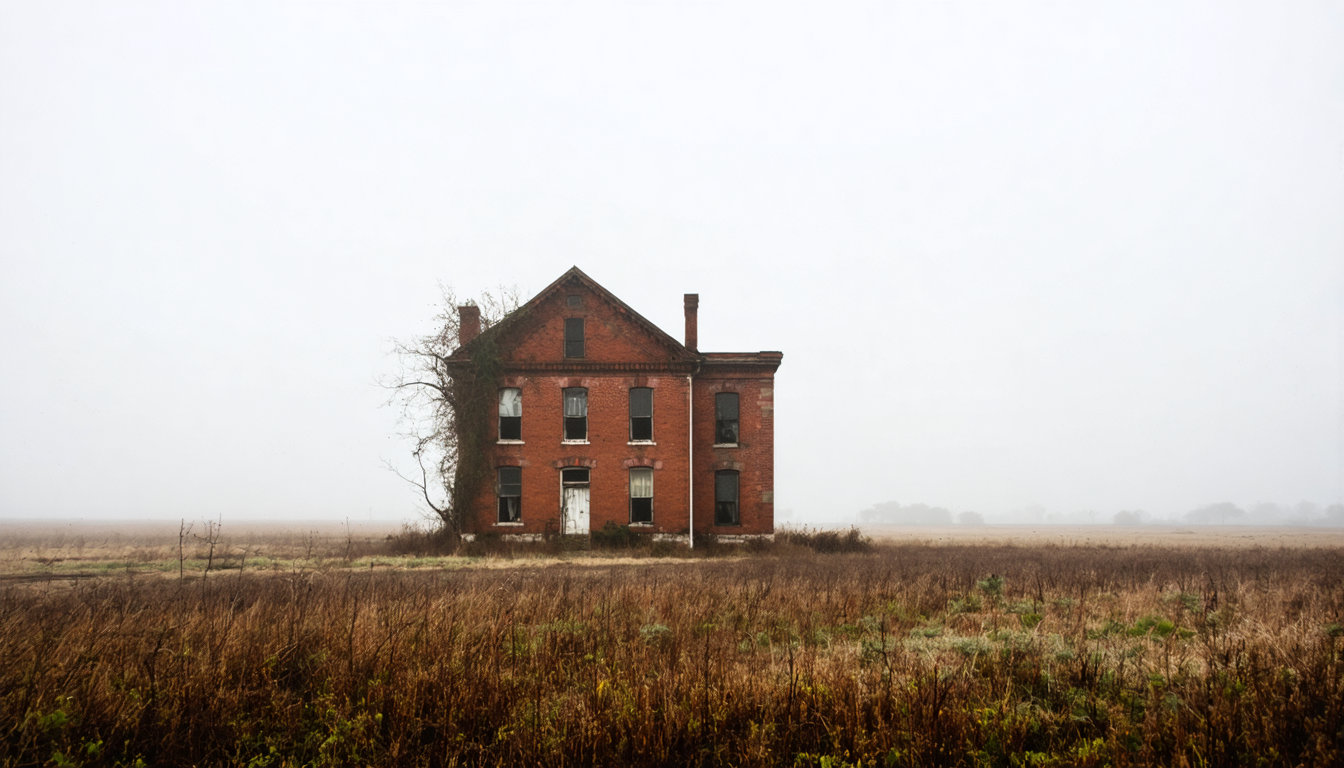
Someone on a podcast this week explained to me that socialism failed in two years. He was talking about New Harmony, Indiana — Robert Owen's cooperative experiment, which collapsed by 1827 because, as the argument goes, people would not work without private incentive. Eight hundred people arrived voluntarily, discovered they did not want to labor for the collective good, and left. Case closed. Human nature adjudicated.
The host delivered this verdict with the calm of a man who has never had to ask whose definition of work was operative in Indiana in 1825 — or what was happening on the land next door. I have been sitting with this for hours now, here in Paris where I came decades ago to survive the definitions America had already assigned me, and I find I cannot let it pass. Not because the man is wholly wrong about New Harmony. But because what he calls nature is actually history, and the history is one he has not bothered to read.
The plantation solved the free-rider problem. Let us be precise. The system thriving within a day's ride of Owen's failing commune had achieved perfect incentive alignment: make the worker the property. The economist's beloved price signals were, for most of this nation's history, the price of a human being at auction. When the man on the podcast says people will not work without reward, he is describing a truth — but the reward that built America was not a wage.
It was ownership of another person's body.
Endless meetings replaced actual work — now that I believe. I have been in rooms like that. The revolution devours itself not in violence but in procedure. Owen wrote seven constitutions in two years. This is not idealism.
This is the inability to begin.
But here is what truly interests me: the word 'voluntary.' They use it as though it closes the case. People chose to come. People chose to leave. Therefore selfishness is bedrock and cooperation is fantasy.
But consider what the word excludes. Nobody calls the labor of the enslaved involuntary in order to discredit capitalism — we do not say the system worked only because it rested on force, therefore its results are void. We say it worked, full stop, and move to the gross domestic product. The asymmetry is instructive. When a commune fails voluntarily, that failure testifies to permanent human nature.
When an economy succeeds through coercion, that success testifies to nothing except progress — a difficulty overcome, an inefficiency on the way to the real story. The standard is never applied evenly because applying it evenly would require you to say this: American prosperity is not evidence of human nature either. It is evidence of what can be extracted from people who have no choice. Owen's commune failed because eight hundred strangers did not yet possess the practical structures or the depth of mutual obligation a shared life demands. That is a real failure — of capacity, of spiritual readiness, of institution.
But it is not a failure of possibility, and the difference between those two verdicts is everything.
Now someone will say: you cannot compare a two-year commune of eight hundred volunteers to a continental republic spanning centuries. And in a narrow sense that is true — the differences in scale, duration, institutional complexity are real. I do not deny them. But I am not making a comparison of equivalents. I am making a comparison of the mercy we extend.
The Constitution that survived — the one we actually live under — required a civil war and a century of organized terror merely to begin extending its promises past the men who drafted it. We are not done. We have barely started. Yet nobody calls that experiment a failure of human nature. They call it America.
They call it a work in progress. The commune lasted two years and is definitive proof of what people are. The republic has been failing Black people for two hundred and fifty years and is still, somehow, a story of aspiration.
The trick — and it is a trick, performed so often it has become invisible — is to treat the collapse of a two-year commune as final evidence about human nature while treating the ongoing collapse of entire populations under capitalism as an externality, a regrettable inefficiency, a problem for the next innovation cycle. The podcast host speaks of incentive structures as though they were natural law, as though the market were weather. But weather does not choose whom to drown. The market chooses daily. It has always chosen.
What I want to ask — and what no one on these programs seems willing to hear — is not whether common life is easy. It is not. Owen himself proved it is grueling, that it demands more of people than most people have yet learned to give. The question is whether the difficulty of common life proves its impossibility or merely measures what it would actually cost us to stop failing each other. Because I know what the alternative costs.
I grew up inside that cost. I have watched it break people who did everything the system asked and were still found wanting — not because they lacked incentive but because the incentive structure was never designed to include them. That is not nature. That is architecture.
I am not selling a program. I have no five-point plan. What I have is a suspicion born in Harlem and sharpened in exile: when a man tells you selfishness is nature, ask him whose nature he studied and under what conditions.

The Fourth of July passed yesterday and I spent it, as I have spent many, outside the country whose birth it celebrates, listening to Americans explain why every alternative to their arrangement is impossible. The confidence is breathtaking. It is also terrified. Because if New Harmony's failure in two years is definitive, then so is every failure — including the ones accumulating now, quietly, in every city where a man works two jobs and cannot see a doctor. The commune's sin was that it could not make strangers love each other fast enough.
The republic's sin is that it has had two and a half centuries and has not yet decided whether it wants to.