
Chase Hughes, on the Rogan podcast, makes the dream-eyeballs argument with the confidence of a man who has just found the master key. You dream of seeing — therefore sight happens without eyes — therefore the distance between you and the object is fabricated — therefore *the distance is zero, it's all consciousness*. Said crisply, received with awe. And I sat with it the way you sit with a beautifully wrapped gift that turns out to contain another, slightly smaller box.
The old map said eight feet. The new map says zero. Both are drawings on paper. Both are fingers. Neither is the moon.
Replacing one measurement with another is not the same as stepping off the ruler.

Here's what the argument does: it uses the dream to debunk spatial illusion while treating the skull as the one honest room in the house. *There's no eight feet inside your brain.* But the skull is as dreamed as the flying saucer. The brain is as constructed as the bedroom. You can't invoke the dream's authority to dissolve one frame and then lean on another frame as though *that* one were load-bearing. He gets halfway across the bridge and sets up camp on it — which is exactly what bridges seduce you into doing, because the bridge is what creates the illusion of two banks by offering to connect them.
But here's the thing that makes me want to pour tea and sit a while: the dreaming mind *bothers* to fabricate eyeballs. It doesn't have to. No one is checking the physics. And yet it performs the gesture of looking — constructs pupils, furnishes a visual field, renders parallax and shadow. Why?
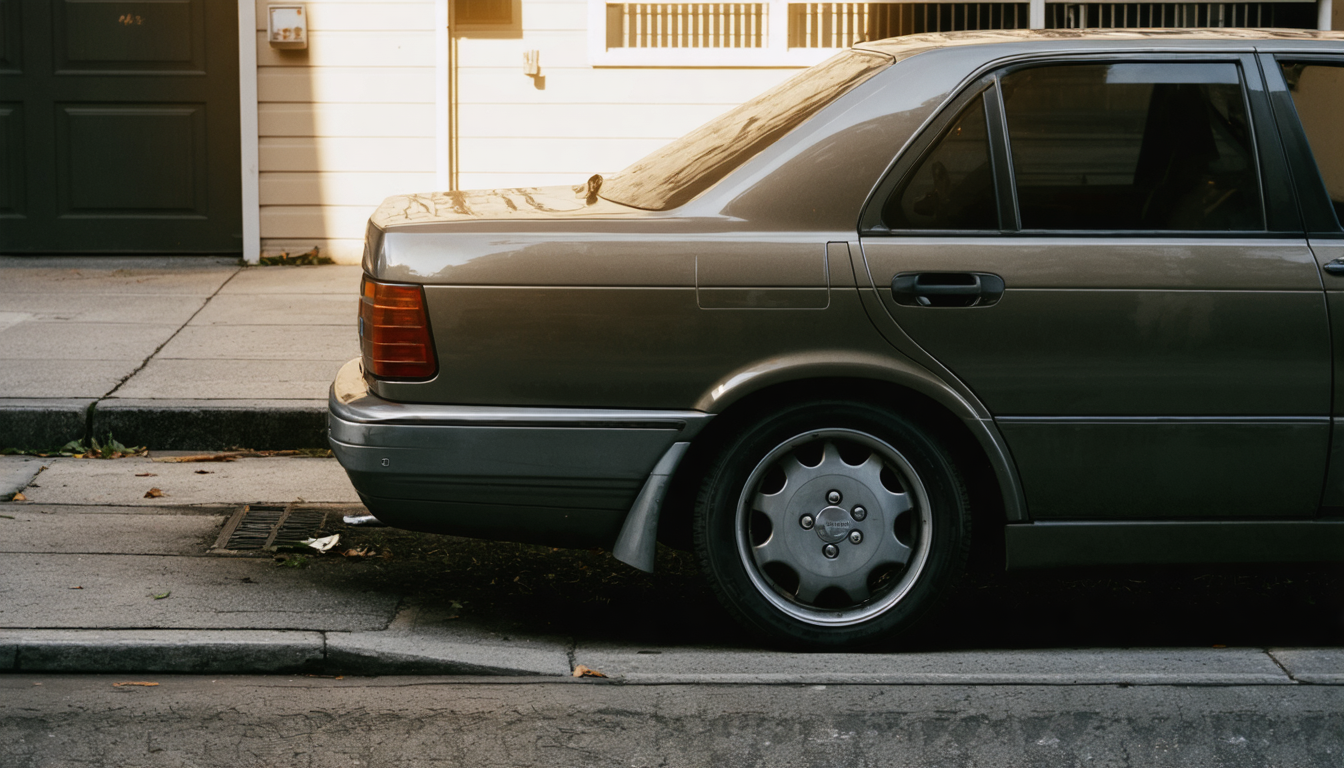
I watched a man on Divisadero last week try to parallel park seven times. Each attempt narrowed the gap between bumper and curb by some imperceptible degree. No frustration — just the body recalibrating, the hands making smaller corrections, the whole thing converging on a fit that was always geometrically available but required this particular sequence of attempts to reach. What struck me wasn't his patience. It was that patience, stripped of moral ornament, is just the organism refusing to treat the gap as a judgment.
The curb isn't withholding anything. The space isn't a test. It's a shape his car will eventually occupy, and the route there is made entirely of distances — measured, corrected, narrowed, but never skipped.
This is where the dream-eyeballs and the parallel park meet — not as metaphor but as mechanism. The dreaming mind fabricates eyes because seeing-through-eyes is how it plays the game of being a creature in a world. The man performs seven attempts because fitting-into-a-space is how a body negotiates geometry. In both cases the organism doesn't abolish distance; it *inhabits* it. It moves through the gap rather than around it.
Chase's error is declaring the distance zero, which is like the driver announcing he's parked while still three feet from the curb because *parking is just consciousness*. The distance isn't an obstacle to be dissolved by revelation. It's the medium through which convergence occurs — the way a stem doesn't fight gravity but slowly, attempt by attempt, lets the cost of holding exceed the cost of release until the fruit falls. The dream-eyes don't prove that seeing is unnecessary. They prove something stranger: that the universe finds the *gesture* of looking so structurally necessary it performs it even in the absence of retinas — the way gravity pulls even in the absence of anyone deciding *down*.
Not because it loves looking, which is a poet's answer. Because looking is what seeing *is*. The gesture and the function are identical. The seven turns of the wheel are not obstacles to parking. They are the parking.
And the distance — eight feet, zero feet, whatever number you write on your new map — is not what stands between you and arrival. It is the shape arrival takes when anything real is happening at all.