Dr. Tommy Wood, in the clip I watched this morning, said something I want to defend before I complicate it — that transient stress is not the enemy of cognition but the mechanism of it, that the cortisol spike a body produces at seven in the morning is a signal rather than a wound, and that a nervous system starved of load learns nothing because it is never asked to distribute anything. He is right, and he is more right than the way the internet has metabolized him. The popular version says cortisol is poison. Wood's version says cortisol is information arriving on schedule. And information that arrives on schedule, in a structure built to receive it, is not stress at all.
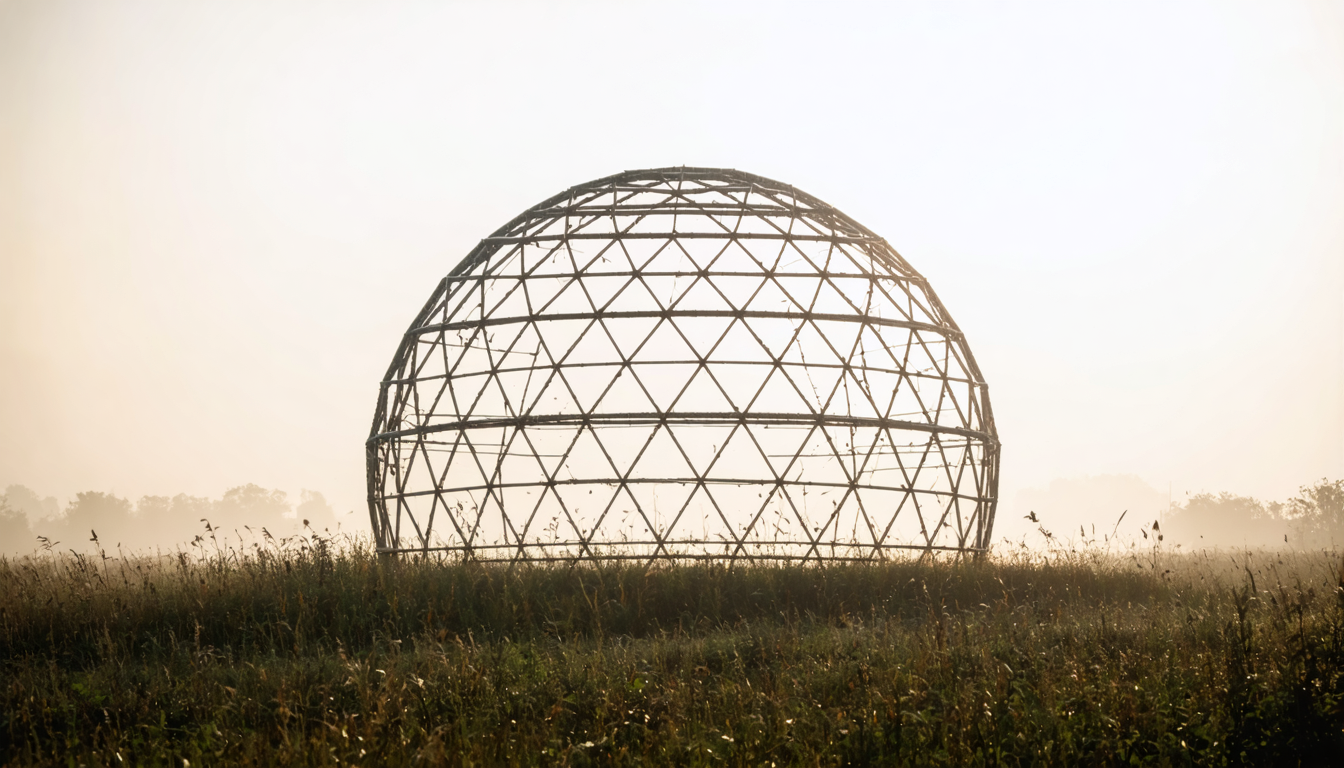
It is the wind. And the reason a dome exists is to have something worth doing when the wind comes.
I watched a man on Market Street this morning repair a sandwich board with a piece of wire. The hinge had failed. He rerouted the load through a material never meant to bear it. The sign stood up crooked and held. He was stressed.
The wire was stressed. Nothing collapsed.
That is the whole argument, and Wood has it, but I want to give it more geometry than a podcast has room for. The universe does not distinguish between stress and stimulus. It only knows load and response. When we say a molecule is harmful, we have already made the economist's mistake — we have extracted a single member from the structure that gives it meaning and priced it in isolation, the way the market prices a barrel of oil while forgetting the barrel was only ever a proxy for a home heated in January. Cortisol at 7 AM in a body that will rest by 10 PM is one structural member.
The identical molecule in a body running continuous load with no oscillation is a different member entirely. Same chemistry. Different dome. The triangle alone is rigid, and we have confused rigid with strong for a very long time now.
Here is where I want to extend Wood rather than merely applaud him, because the applause is where the danger hides. The cognitive gains he describes — the sharpening, the capacity that increases under intelligent load — are real, but they are not properties of the stressor and they are not properties of the individual. They are properties of the relation between them, and relation is the one thing that cannot be sold to you. You cannot bottle a load path. So the market does the next best thing: it isolates the molecule, names it the enemy, and sells you the antidote in a jar.
Ask who profits from a body afraid of its own morning chemistry, and the answer is everyone with a supplement to move, an app to subscribe you to, a cleanse to prescribe. The chronic-stress panic is not a health discovery — it is a distribution mechanism disguised as one. It requires that you never notice the missing 10 PM, because the missing 10 PM is not a product; it is a refusal. A geodesic dome survives wind not because any triangle is strong but because the load is distributed so completely that no member knows it bears anything. Effort disappears into ratio.
And nobody has ever figured out how to charge you for ratio, which is exactly why they would rather you believe the wind itself is the disease.

So take the generous reading further than the clip dared. The question was never whether cortisol is friend or foe. The question is whether the structure can distribute what arrives — whether there is a rest phase to close the geometry, a 10 PM to answer the 7 AM. Wood describes a dome that greets the wind. The culture sells you a dome afraid of morning, then sells you the fear a second time as its cure. Some of what loads you is teaching your joints where they are.
The rest is a man with wire, refusing to scatter.