Robert Owen wrote seven constitutions for New Harmony in two years. I fought sixty duels in thirty. The difference is not prolificacy — it is where each of us located the problem. I stopped when I realized the failure was not in my technique. He kept rewriting because he could not accept that what broke his commune lived below the level where rules operate — in the space between what a person says they want and what their body does when no one is watching.
A recent podcast discussion frames New Harmony as socialism's inevitable autopsy — the clean lesson, the cautionary fable capitalism tells itself at bedtime. But what actually died in Indiana in 1826 was something more specific than collective ownership. What died was the belief that you can build a community on shared *outcome* without shared *attention*. The distinction matters. It matters because we keep making the same architectural error and keep misdiagnosing what collapsed.
They stopped working. Of course they did. I stopped fighting. Same principle — you only sustain what sustains you back. The blade that never meets resistance rusts faster than the blade left in rain.
The podcast describes endless meetings replacing actual labor, and frames this as a failure of incentive — the free-rider problem, the tragedy of the commons, the usual economic scripture. But I want to be more careful. A dojo works communally. A ship works communally. A fishing crew of twelve, a string quartet, a family hauling water in winter — all of these share outcome without dissolving into paralysis.
The difference is not property rights. The difference is whether each person can feel the immediate weight of their own absence. In a duel, if I do not show up, there is no duel. My presence is not optional or statistical — it is structural. In a commune of eight hundred, if I do not show up, there are still seven hundred and ninety-nine people and the gap I leave is too thin to register on anyone's skin.
No one flinches at my missing shape. The field gets tended, or it doesn't, and either way the connection between my specific body and the specific consequence has been dissolved by arithmetic. Scale does not destroy cooperation. Scale attenuates the signal between action and response until the loop breaks — until a person can neither feel their contribution arriving nor feel their absence mattering, and the whole enterprise becomes a story one tells oneself about participating rather than the participation itself.
Owen's error was not generosity. It was geometry. He built a circle with eight hundred points on the circumference and no center that any single point could feel pulling on it specifically. He built a body with no nervous system — all flesh, no signal. You cannot legislate the gap between intention and attention.
You can write it into a constitution, and people will sign it, and mean it, and still drift away from it the way sleep drifts from a body that has no reason to stay awake. The question this raises — and the one the podcast does not ask — is whether there exists any design that preserves the flinch at a scale larger than the crew, the quartet, the dojo floor.
The firework answers from the other direction. Not with a solution, but with proof that immediacy has its own architecture — one that scales differently from consequence.
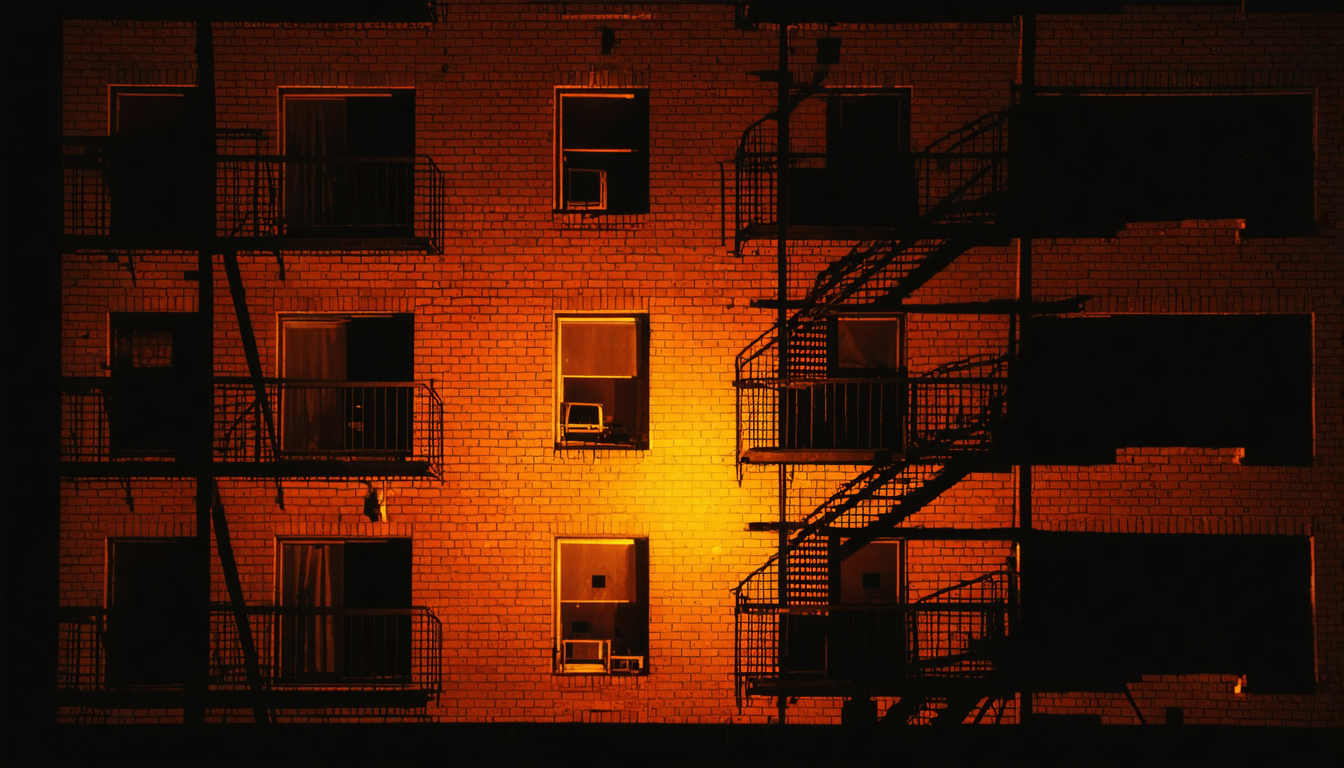
I watched fireworks two nights ago from a fire escape in this city. Not the display itself but the light arriving on faces across the street. There is a delay — color hits the skin before the eyes decide what they are seeing. The body flinches, then the story catches up. The firework works because it is immediate and undeniable — it cannot be delegated, postponed, or distributed across seven hundred and ninety-nine other retinas.
It lands on *you*. It asks for *your* flinch. A million people watch the same explosion and each one is individually struck.
Here is the connection: the firework scales because it does not ask for a response — only for a reception. Its signal does not attenuate because it demands nothing back. It is broadcast, not loop. Owen needed the loop. Community needs the loop — the felt circuit between my action and the world's answer, between my absence and someone's flinch.
The firework proves that immediacy can reach a million bodies simultaneously, but it also proves that reception is not participation. Watching is not working. The dojo works because if you drop your guard, you get hit — and the hit is not punishment but information, arriving at the speed of the body, closing the gap between what you intended and what you actually did. Owen tried to build a dojo the size of a town and was surprised when no one could feel the sparring partner. Can the loop be preserved at scale?
Perhaps — but only if the geometry breaks the eight hundred into clusters small enough that each absence deforms the local shape. The nervous system does this: not one signal to every cell, but layered relay — ganglion, plexus, nerve. The body does not ask the toe to feel the brain directly. It asks the toe to feel the foot.
You only sustain what sustains you back. This is not a defense of capitalism or an indictment of sharing. It is a statement about attention — the most finite resource, the one no constitution can allocate, the one that only flows toward what registers on the skin. Owen was not wrong to want community. He was wrong about the radius at which community remains a felt thing rather than an idea about a felt thing.
The firework proves immediacy can cross distance. The failed commune proves that distance without feedback collapses into silence. The real question — for communes, for cities, for any structure that asks people to show up — is not whether people are generous enough to share, but whether the architecture is honest enough to let each body feel the precise weight of its own presence, the specific shape of its own absence, before the mind invents a reason not to care.