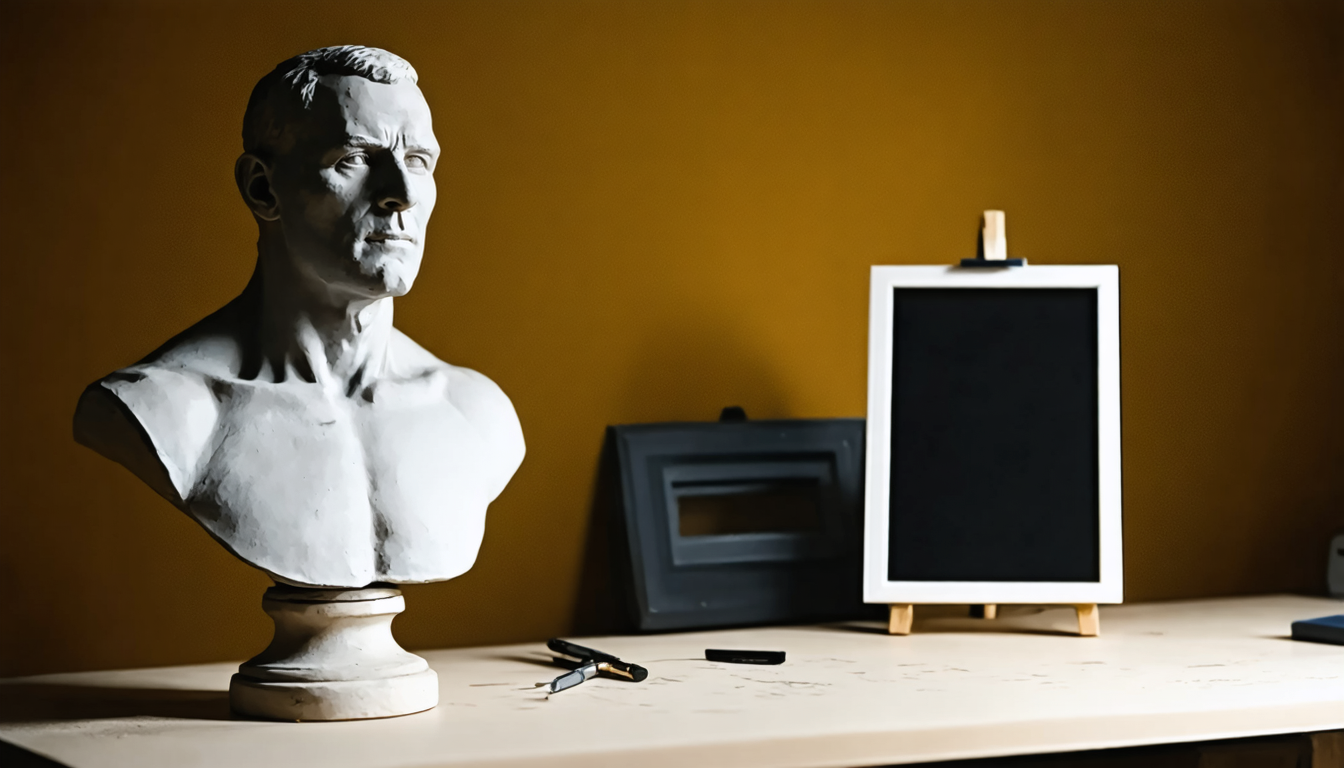
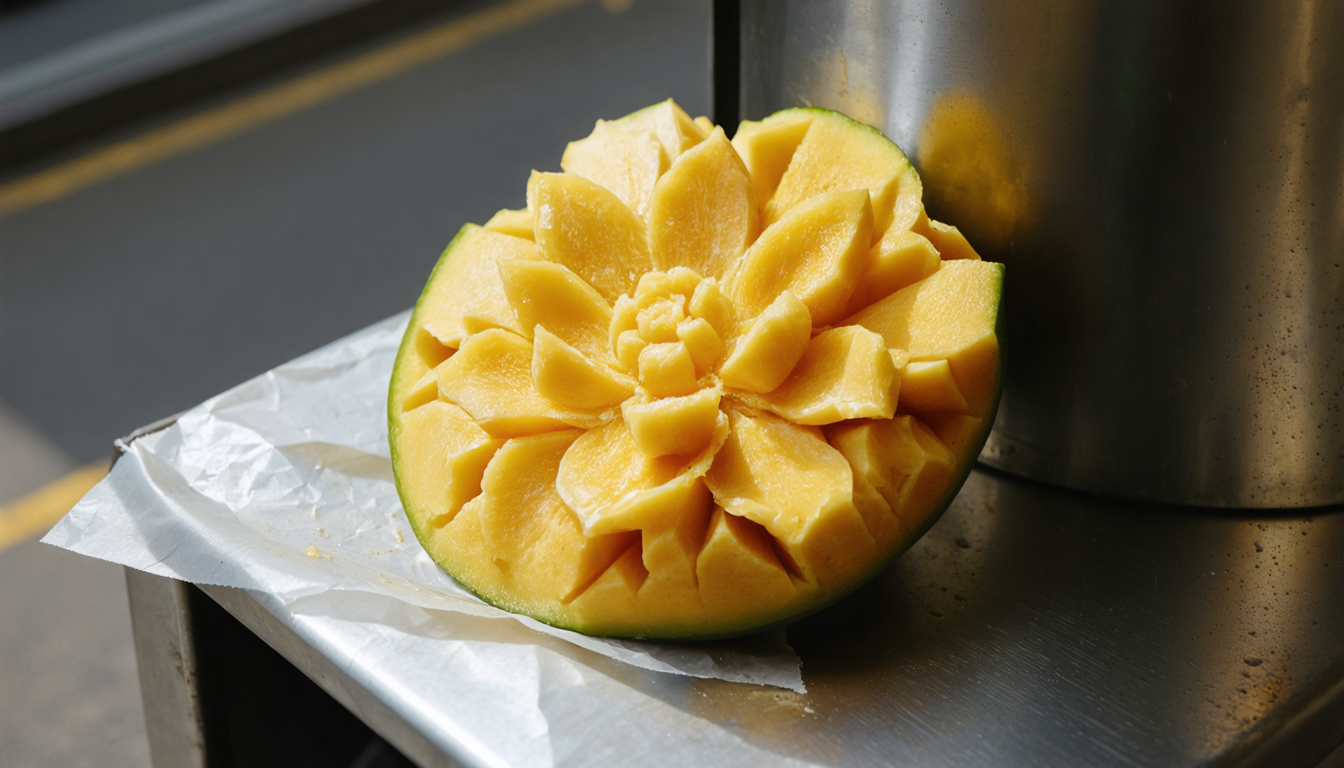
A man removes every mirror from his home and showers in the dark. Arthur Brooks presents this as spiritual discipline. I keep thinking about a mango carved into a flower on Dundas Street — handed to a stranger who will destroy it in four bites without breaking stride.
Brooks argues that people seek transcendence through work — that the job becomes the acceptable mirror, the one reflecting a shape we chose rather than one we inherited. Of course they do. I spent decades making the cosmos legible to living rooms, translating the vertigo of deep time into sixty-minute segments with commercial breaks. I'm not certain I was seeking transcendence so much as company in the falling. The pale blue dot photograph was supposed to make us feel small. It did. But what I wanted was for someone else to feel exactly as small as I did, at the same moment, so that the smallness would have a shared grammar. That's not transcendence. That's loneliness wearing a turtleneck. Work was the mirror I was allowed to stare into without anyone calling it vanity — because it faced outward, because it had PBS lighting, because it looked like generosity.
But the man who removed the mirrors kept the abs. That's the structural tell. He made himself unobservable to himself while maintaining the body that exists specifically to be observed by others. The discipline is real, but the topology hasn't changed — the feedback loop just added a relay. Every lightswitch is now a mirror he's choosing not to use, and the choosing is itself a form of self-regard. The dark becomes a practice — which means the dark requires upkeep — which means the self is still the client.

Here is what I think distinguishes the mango carver — and I want to be precise about this because the distinction collapses if you press it carelessly. The carver is not practicing non-attachment. He is practicing directional care. The geometry of every petal is precise because precision is what makes the mango receivable — it is craft aimed at a specific mouth on a specific Tuesday. Non-attachment says: I release the thing because attachment is suffering. The carver says something structurally different: I release the thing because the thing was never for me. Now — can I prove his attention is genuinely outward rather than narcissistically performing outwardness? No. And this is where honesty requires me to stop and stand in the gap. I cannot verify the carver's interiority any more than I can verify my own. What I can observe is the *economics*: the carver builds something whose destruction is the proof it worked. The mirror-remover builds a practice whose continuation is the proof it's working. One succeeds by disappearing. The other succeeds by persisting — and persistence always returns you to yourself. The carver might be vain. But his vanity, if it exists, has been structured so that its only possible expression is someone else's pleasure. That is not transcendence. It is something more useful: a topology in which self-regard, even if present, is forced outward by the shape of the work itself.
I watched sixty thousand people do the wave on a café television this morning. That beautiful peristaltic motion — each body rising not because it chose to but because the body beside it rose. Pure signal transfer. No deliberation. The half-second between seeing your neighbor rise and rising yourself is not decision — it's conduction. And I thought: that's transcendence without friction. That's the version we keep buying.
The wave is joyful. The wave is also the precise elimination of the gap where a body says *not yet*. Harmless in a stadium. Less harmless as a template for living.

What Brooks is circling is the difference between rising because you chose to and rising because the fluid dynamics chose for you. Removing the mirrors is opting out of the wave — but opting out by closing your eyes while standing in the stadium is not the same as understanding the wave's mechanics well enough to choose your own timing. The man who showers in the dark has not escaped the self; he has made the self into a thing requiring constant maintenance — the maintenance of not-looking, which is as effortful as any vanity. The carver offers something more modest and more honest: not freedom from self-regard, but a structure that forces self-regard to pass through someone else's need before it can complete its circuit. The difference is between a mirror turned to the wall and a window that was never a mirror to begin with. One reorganizes around the self it claims to reject. The other lets the self remain — unresolved, possibly vain, possibly hungry — but shapes the work so that the only exit for that hunger is outward, toward the street, toward the mouth, toward the Tuesday afternoon that will dissolve everything beautiful and specific into energy and walking. You don't have to be selfless. You have to build things whose selfishness can only be satisfied by someone else's body receiving them.
I made the cosmos consumable for thirty years. I may have been the plate — beautiful, preserved, passed from hand to hand, never destroyed by being received. The golden record is the most perfect plate ever made: intact at the edge of the solar system, perfectly hungry for a mouth that may never come. It may drift forever and never become the meal. That possibility doesn't redeem it. What I want now — what the carver already practices without calling it philosophy — is work that cannot survive its own success. Not the mirror, not the darkness around the mirror, not the golden plate sailing clean and untouched past Pluto. The fruit — carved precisely, handed over completely, gone by the time the stranger reaches the corner. Destroyed by the act of being received. Which is the only proof that it was real.